31.01.14
Clause 118 controversy continues after amendments
Campaigners have welcomed government amendments to the controversial clause 118 of the Care Bill ensuring more consultation on decisions around hospital reconfigurations – but many still want it scrapped altogether.
The amendments brought forward by the government mean consultation provisions would be extended to other provider trusts, their staff and affected commissioners.
The clause extends the remit of Trust Special Administrators (TSAs) to allow them to make recommendations about other trusts in an area.
Before the debate, the RCP, FTN, AoMRC, and NHS Confederation called for thorough consultation to be conducted ahead of any redesign. This consultation must be substantial and conducted at a stage when it is truly meaningful, they urged.
It follows the case last year when a judicial review ruled that health secretary Jeremy Hunt did not have the powers to reconfigure Lewisham Hospital, which had been a recommendation by TSAs at neighbouring South London Healthcare NHS Trust.
Campaigners and unions are concerned that clause 118 could remove the protections that allowed Hunt’s decision to be overturned. Others say it marks another step in the “dismantling” of the NHS.
Mark Porter, chair of the BMA council, welcomed the amendments and said: ‘We’ve called for changes to put this right. These amendments are a step in the right direction in making sure that staff and managers at neighbouring trusts affected by a TSA recommendation in the future will be properly consulted and their responses considered.
“It must be recognised that the impact of a trust special administrator investigation on neighbouring trusts affects not only clinicians but can also lead to patient uncertainty, huge cost to the taxpayer and have long-term negative consequences for proper planning of local healthcare services.”
Dr Brian Fisher, GP and NHS Alliance patient and public involvement lead: “We need to fight against these plans, which will enable rapid and virtually unchallengeable reconfiguration across the country, cutting across CCG and public collaboration and involvement.
“Our experience in Lewisham is that the TSA process is dangerous and flawed. I live and work in Lewisham and I am part of the Save Lewisham Hospital Campaign. A totally new reconfiguration was proposed, beyond any previous suggestions: this made it difficult to explain and respond. It was inaccurately and inadequately described: it left out any mention of the major impacts on paediatric and mental health services. It distorted evidence and statistics. It did not follow agreed procedure: it omitted an equalities impact.
“It could be you next time. We did not expect this in Lewisham – we have a thriving and financially solvent trust. We became the fall-guys to solve the finances of a trust in another area. There are plenty of trusts out there over which the TSA process is hovering.”
NHS Alliance chair Dr Michael Dixon, who sits on NHE’s editorial board, added: “Reconfiguration is terribly important at the present time. But it must have the agreement of local CCGs and local people. Anything less is not fair to either.”
The UNITE union warned: “Hospitals will be shut at the whim of Whitehall bureaucrats, without full and proper consultation with patients and the public, and without even any agreement from the new GP commissioning groups (CCGs).
“This means that even if your local hospital is successful and financially viable it can be shut if a neighbouring NHS trust is failing – no matter how vocal local opposition is to the plans.”
Activists associated with various ‘save our hospital’ campaigns have been particularly concerned at the plans, as have groups with wider concerns about government health policy, including 38degrees, the National Health Alliance party, and the NHS Support Federation.
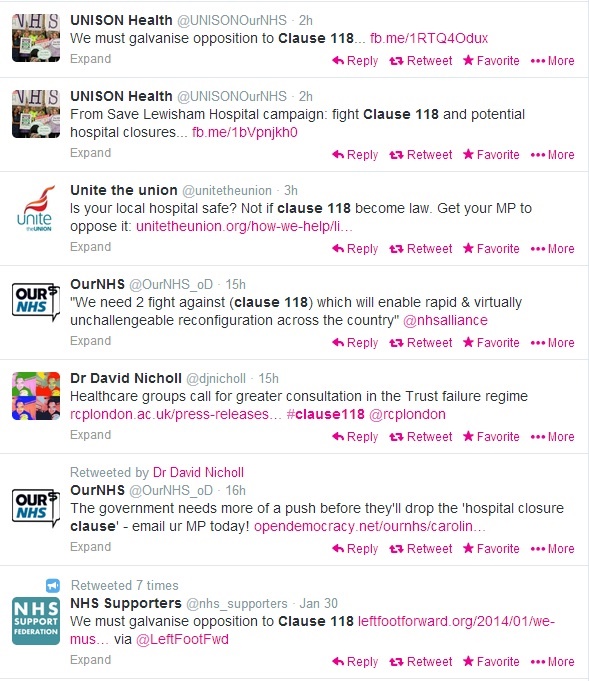
A sample of recent tweets on the issue:
But Nuffield Trust chief executive Andy McKeon suggested some of the controversy was overblown. He wrote: “Some have suggested this is a backdoor, easy way of achieving reconfigurations involving decisive but, for the local public, undemocratic action. The policy and NHS community is a bit two faced about this.
“We say widespread reconfiguration is needed and press politicians to be bold. However, when faced with a clause that might help do this we go ‘oo..er, not sure about that’, rightly recognising the need for public support for change.
“I don’t think this clause is going to be used to achieve widespread reconfiguration. Special Administrators have so far only been involved in South London Healthcare and Mid-Staffordshire. Both are extreme cases. More frequent use of Special Administrators as permitted by Clause 118 might resolve some problems. But there would be a heavy political price to be paid locally and nationally as it would send a worrying message about inadequate funding and poor management of the NHS, especially if successful organisations found services closing as a result of a Special Administrator’s recommendations.”
Tell us what you think – have your say below, or email us directly at [email protected]
Image c. Stefan Rousseau, PA Wire, Press Association Images