
A new report from The King’s Fund warns that political reluctance to address social care has turned the issue into an “electoral taboo”, despite evidence that the public values the service and supports reform when prompted.
The think tank found that while social care briefly becomes a public priority when politicians propose major changes, repeated failures to deliver reform – and intense backlash to previous proposals – have made political leaders wary of raising the subject.
The most high‑profile example was the 2017 General Election, when controversy surrounding the so‑called “dementia tax” derailed proposed social care reforms and led to sustained political caution. The report argues this moment continues to cast a long shadow over future efforts to address challenges in the sector.
The King’s Fund analysis of polling and focus groups since 2011 shows that unprompted public concern about social care has plummeted. After peaking at 18% in 2017, social care has since dipped to record lows of 1–3%.
In October 2025, only 3% of people identified social care as one of the most important issues facing the country, compared with 47% citing immigration, 33% citing the economy, and 24% citing the NHS.
The report highlights widespread public confusion about what adult social care is, with around one‑third of people wrongly believing it is provided by, or free through, the NHS. This misunderstanding stems from:
- Overlap between NHS and social care services
- The broad range of services included under social care
- The fact that relatively few people draw on social care at any one time
- A general reluctance to think about ageing and care needs
Despite this, the public consistently underestimates their own likelihood of needing care – even though one in seven people aged 65 will face lifetime care costs exceeding £100,000.
The King’s Fund found that when social care is listed as an option in polling, nearly one in three people say it should be a priority. Many also:
- Link social care reforms to improving NHS performance
- Believe government should take greater responsibility for funding
- Support changes that would make the system simpler, fairer and easier to access
This contrast between unprompted and prompted responses suggests that public disengagement is driven by lack of understanding, not lack of concern.
Senior Fellow for Social Care at the King’s Fund, Simon Bottery, said:
“Social care reform is caught in a political Catch-22: it needs politicians to build support for change, but they avoid talking about it for fear it will lose them votes. It will take more courage and leadership from them if social care reform is going to happen and realise the electoral and societal benefits that fixing this failing system would bring.
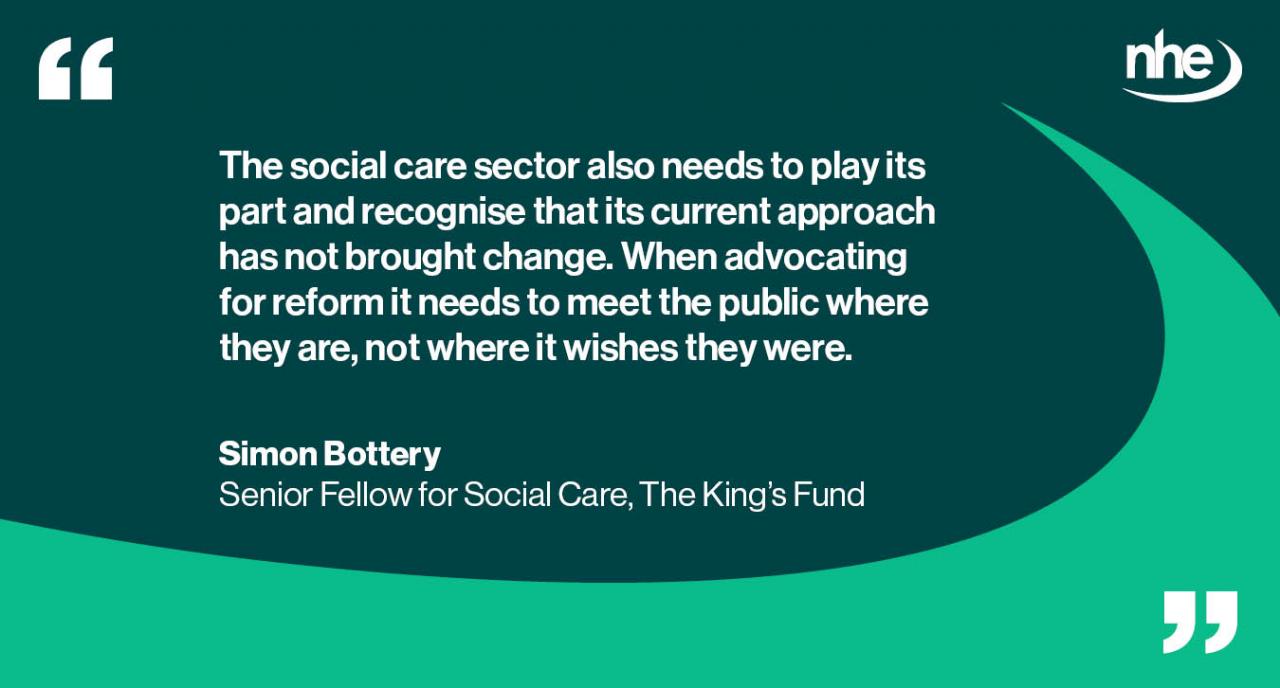
“The social care sector also needs to play its part and recognise that its current approach has not brought change. When advocating for reform it needs to meet the public where they are, not where it wishes they were.
“That means talking about the benefits of reform to the NHS, which the public uses more and prioritises more than social care. Also, speaking to the tangible improvements that reform would bring like shorter waiting times to receive care and more people receiving it, rather than focusing on abstract concepts such as ‘wellbeing.”
To overcome the longstanding lack of progress, the King’s Fund recommends:
1. Stronger cross‑party dialogue
The report argues that politicians need “air cover” to make reforms without fear of electoral backlash. To date, the only recorded cross‑party discussion has been via the Casey Commission. More structured collaboration will be essential to build consensus and public confidence.
2. Mobilising the 1.5 million‑strong social care workforce as ambassadors
Social care staff could help increase awareness by sharing their experiences through personal and community networks, helping to improve public understanding and support.
3. Communicating tangible benefits of reform
The King’s Fund urges campaigners to adopt clearer messages that outline what reforms would achieve — in the same way NHS investment is often summarised as “more doctors and nurses”.
Examples of relatable messages include:
- Shorter waiting times for care
- More people receiving support
- Improved quality of life for those who draw on care
The report, Not my priority: how the public sees social care (and what can be done about it), is the first in a wider programme of work examining possible social care reform models as part of the King’s Fund’s new strategic focus.
It concludes that while political challenges remain significant, public consent for reform is achievable, but only if awareness is raised, communication is improved, and consensus is built across the political spectrum.
Image credit: iStock