

New polling from the Health Foundation’s third annual Health Tech Tracker shows strong public backing for most of the proposed new features of the NHS App, but lingering caution about the use of artificial intelligence in healthcare.
The survey – one of the largest of its kind, with responses from 8,000 members of the public and more than 2,000 NHS staff – comes as the government’s 10‑Year Health Plan sets out ambitious plans to expand the role of the NHS App in everyday care.
The research reveals that around three quarters of the public would be happy to use the NHS App for a variety of new services, including booking a hospital appointment, choosing a preferred hospital, and accessing information about procedures.
These high levels of support suggest positive public appetite for digital innovation that improves access, convenience and transparency.
NHS staff also hold favourable views, with 60% saying technology improves care compared with 55% of the public.
Support falls sharply when AI is introduced into patient pathways. Only 49% of the public say they would be willing to use the NHS App’s proposed AI‑powered “Doctor in Your Pocket” feature for non‑urgent care. Nearly a third (32%) say they would not use it at all.
The public and NHS staff remain more hesitant about AI than digital technology overall:
- 38% of the public believe AI will improve healthcare quality
- 19% think it will make care worse
Across all demographic groups, the polling highlights a clear message: safety and human oversight come first.
When asked to consider trade‑offs, 70% of people said they prefer AI outputs to be checked by a human, even if this slows results, whilst 72% want strong evidence and regulation, even if this delays rollout of new tools.
These findings emphasise the public’s desire for robust governance and transparent testing of AI systems in the NHS. The survey also reveals important differences in attitudes toward digital health technologies.
Senior Improvement Analyst at the Health Foundation, Ahmed Binesmael, said:
“The government’s 10-Year Health Plan set bold ambitions for technology and AI in modernising the NHS. Our findings show the public supports using the NHS App to manage many everyday health care tasks, but is more cautious about AI-generated advice. Meaningful engagement with the public will be essential to get this right – particularly with those that are more sceptical – to ensure new tools meet patient needs and reduce, rather than reinforce, inequalities.
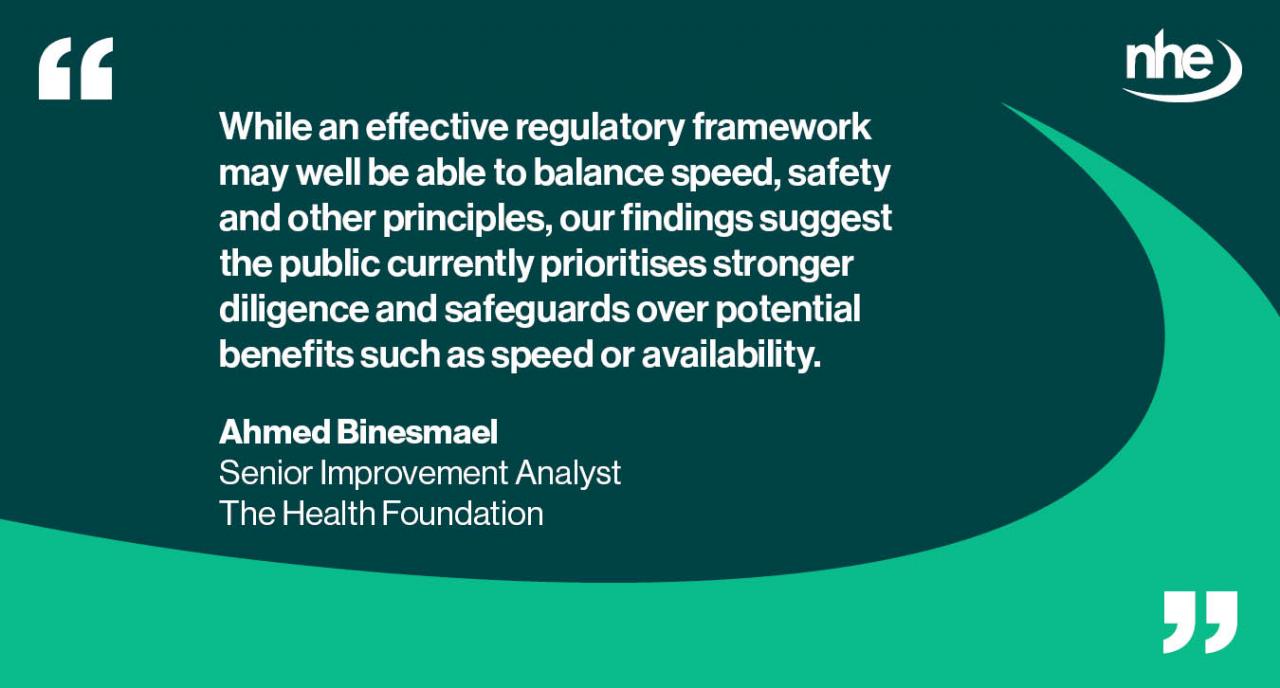
“As policymakers seek to develop the UK’s approach to overseeing and regulating AI in health care, it will be important to create an environment where the use of AI is trusted by patients and the public. While an effective regulatory framework may well be able to balance speed, safety and other principles, our findings suggest the public currently prioritises stronger diligence and safeguards over potential benefits such as speed or availability.”
Groups expressing lower levels of trust include women, young adults aged 16–24, and people on low or no income. For example, among households where the main earner is in casual work or unemployed:
- Only 35% would use the “Doctor in Your Pocket” AI feature
- 36% said they would not use it
Overall, the polling suggests that the public is broadly supportive of digital reform, especially where it improves access and convenience, but remains cautious about AI‑driven care. The findings provide a valuable evidence base for policymakers as the NHS explores expanded use of digital tools and AI technologies, highlighting both the opportunities and the need for careful oversight.
Image credit: iStock