

The Royal College of Physicians has called for urgent clarity on the role of medical specialists in neighbourhood‑based care, warning that uncertainty could undermine efforts to deliver more joined‑up, effective services for patients.
In its new report, RCP View on neighbourhood health, the College sets out a vision for how specialist doctors should contribute to neighbourhood health models, as new data shows nearly half of physicians (48%) are unclear about how their role would function within a neighbourhood health team.
The RCP welcomed commitments in the government’s 10 Year Health Plan to reform outpatient or “planned specialist” care, and shift more services into community and neighbourhood settings.
However, while neighbourhood health models are already being rolled out, the RCP warns that the role of medical specialists, such as cardiologists, gastroenterologists, geriatricians and respiratory physicians, remains poorly defined.
Without clear expectations and structures, the College says patients risk continuing to experience fragmentation between services and professionals, rather than the seamless care neighbourhood models aim to deliver.
The concerns are backed by findings from a 2026 RCP snapshot survey of physicians in England.
Among respondents:
- 48% said they were not very clear, or not clear at all, about how their specialist role would function within a neighbourhood health team
- 42% expressed concerns about how neighbourhood health delivery would affect their day‑to‑day clinical work
The RCP says these findings highlight the need for clearer planning, engagement and support as reforms progress.
Physicians identified several practical issues that they believe must be addressed for neighbourhood models to work safely and sustainably.
Commonly cited concerns included increased workload without protected time in job plans, unclear clinical responsibility and escalation routes for complex patients, reduced capacity for inpatient and outpatient specialist work, and increased reliance on virtual or remote consultations.
Doctors also raised concerns about reduced access to timely diagnostics, specialist advice and hospital infrastructure, alongside growing workload pressures affecting wellbeing and contributing to burnout.
The RCP’s report sets out how medical specialists can be effectively embedded into neighbourhood‑based planned care, ensuring patients benefit from specialist expertise at the right points in their pathways.
It argues this will require a reshaping of how specialists work across the system, supported by changes to workforce planning, education and training, and digital infrastructure.
The College says specialists must be enabled to work flexibly across traditional hospital, community, and neighbourhood boundaries, rather than being siloed into single settings.
The report makes 10 recommendations to the UK government, NHS England, and local health systems.
These include calls for integrated care boards to work directly with physicians to define specialist roles in neighbourhood planned care, including clear clinical responsibilities and thresholds for direct specialist input.
The RCP also wants the forthcoming 10 Year Workforce Plan to explicitly model physician roles within integrated neighbourhood teams, with realistic assumptions around time, skill mix, and protected activity.
Dr Hilary Williams, Clinical Vice President of the RCP, said:
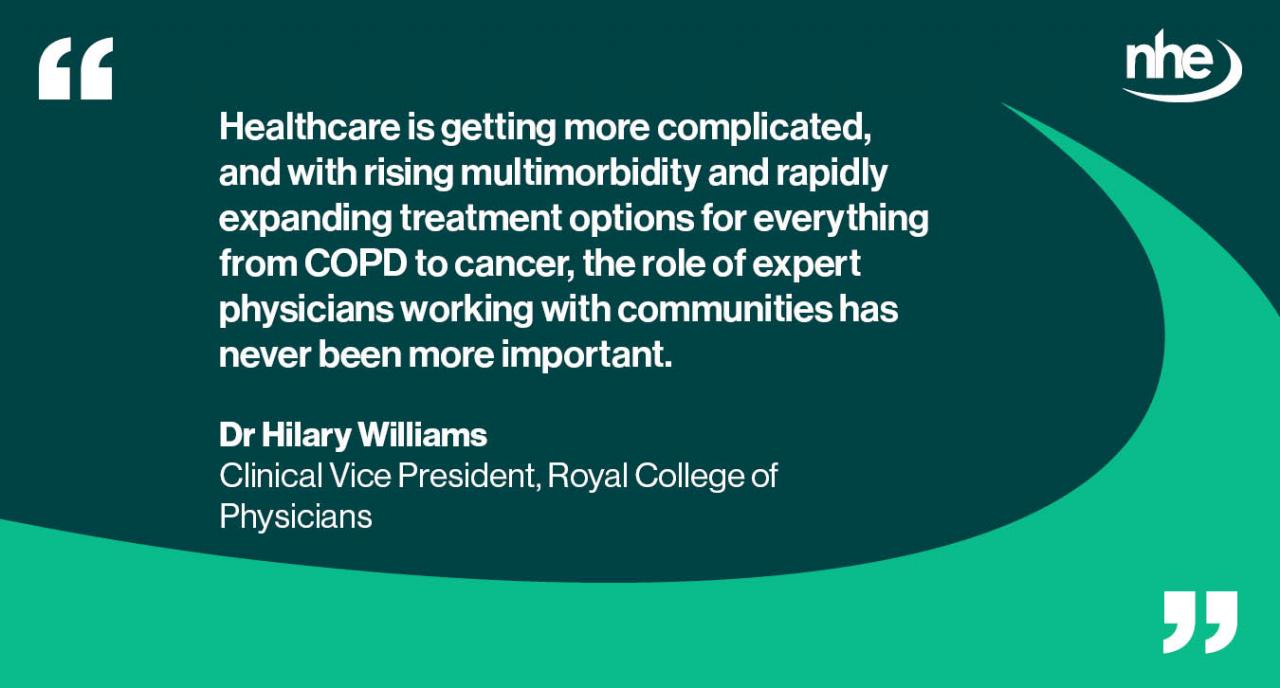
“We know from talking to our members up and down England, that physicians are excited about the opportunities of neighbourhood health, but nearly half are unclear about their future role. Healthcare is getting more complicated, and with rising multimorbidity and rapidly expanding treatment options for everything from COPD to cancer, the role of expert physicians working with communities has never been more important.
“The challenge of modern healthcare is managing complexity and comorbidity – and this is what physicians’ medical training equips them to do. Our report today lays out the RCP’s vision for how neighbourhood health must use that expertise if patients are to see real benefits from these new models of care.
“Neighbourhood working offers significant potential to deliver the reformed approach to planned specialist care that the RCP has long advocated for, but it will only be successful if it brings together the professionals that patients need for safe and effective care – medical specialists alongside primary and community expertise.
“The RCP will work with our members and the NHS to bring our expertise and thinking to shape the role of medical specialists in this new model to ensure patients get the care they need.”
Other recommendations include investment in interoperable digital systems, including electronic patient records, so clinicians can safely share information and make joint decisions, and expanded training opportunities to help doctors develop neighbourhood‑specific skills such as multidisciplinary working and managing risk outside hospital settings.
Image credit: iStock