
Scotland could take more than two centuries to bring extreme Accident & Emergency waiting times back to acceptable levels without urgent political action, according to a stark new report.
The warning comes from the Royal College of Emergency Medicine, which today published fresh analysis highlighting the scale of the crisis facing emergency departments.
According to the report, more than 75,077 patients waited 12 hours or longer in major emergency departments across Scotland last year before being admitted, discharged or transferred.
While this marks a slight improvement on 2024 figures (76,510), the pace of change remains critically slow. With waiting times falling by just 1.8% annually, RCEM estimates it could take 237 years to return to 2016 levels – when only 1,005 patients experienced such extreme delays.
The findings form part of RCEM’s latest State of Emergency Medicine in Scotland report, which details the pressures faced by both patients and frontline NHS staff.
The report also highlights the human cost of prolonged waits. In 2025, 58,870 patients who waited more than 12 hours were awaiting admission to a hospital ward for further care.
Using the Standard Mortality Ratio, a recognised method for estimating risk, RCEM calculated that long waits in A&E may have contributed to 818 excess deaths in 2025 alone. This equates to around 16 deaths every week, a figure unchanged from the previous year.
The methodology suggests that for every 72 patients waiting between eight and 12 hours in emergency departments prior to admission, there is one additional death.
RCEM is now urging sustained political focus to tackle what it describes as an escalating emergency care crisis. Without decisive intervention, the organisation warns that patients will continue to face dangerously long waits, with serious consequences for outcomes and safety.
RCEM’s Vice Chair in Scotland, Dr Jayne McLaren, commented:
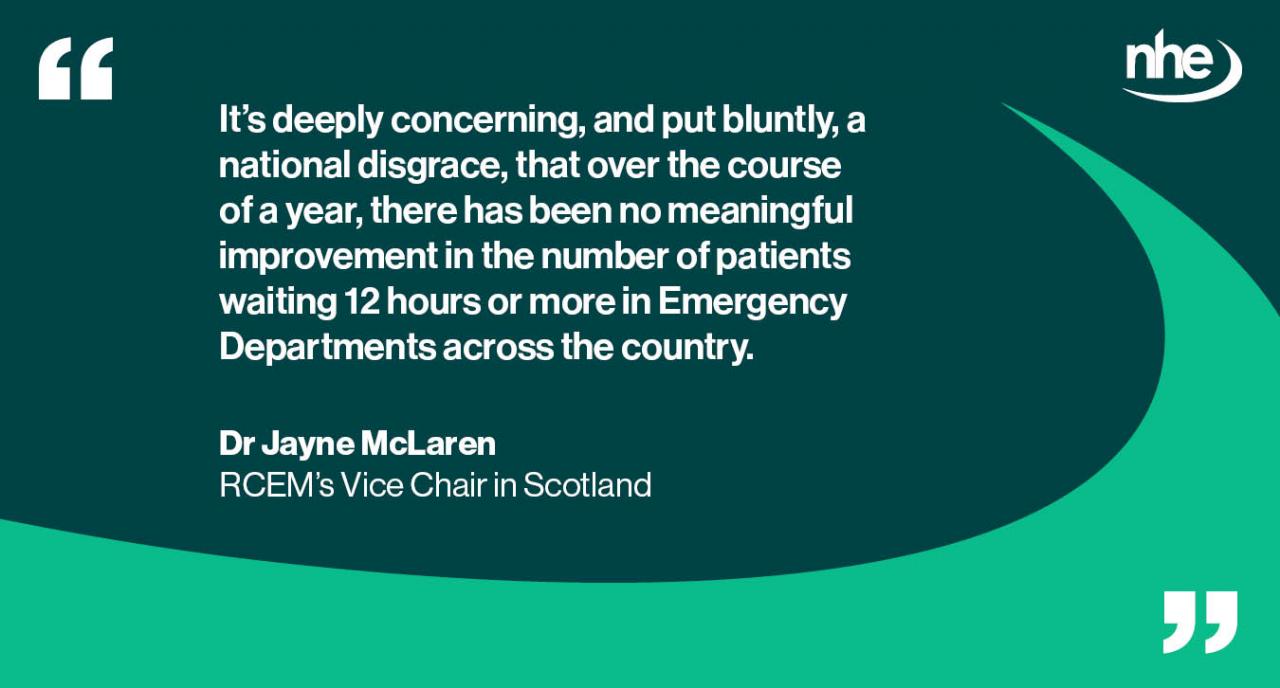
“It’s deeply concerning, and put bluntly, a national disgrace, that over the course of a year, there has been no meaningful improvement in the number of patients waiting 12 hours or more in Emergency Departments across the country.
“A small reduction of just over 1,400 patients waiting this long in the space of a year is nothing to celebrate. Because look at the sheer scale who still waited this long – 75,077. These are people not just numbers. And more often than not, they would’ve experienced this extreme wait on a trolley in a corridor, or another inappropriate space that was never designed to deliver care in.
“But what’s most upsetting, as an Emergency Medicine consultant, whose whole profession is to help people in their time of need, is seeing how many people died because of the system not working as it should. Ultimately, because there wasn’t an inpatient bed for them when they needed to be moved to a ward.
“People are losing their lives. And today’s figures suggest that the same number of people died in association with long waits as in 2024.
“This is a conservative estimate too. We know there may well be many more tragic deaths linked to long stays because this methodology only applies to one group of patients.
“That needs to spark anger and upset from those in power to bring about the changes that are desperately needed in our hospital system.
“Our State of Emergency Care report should serve as essential reading for ministers, NHS leaders and policymakers. It sets out clear, practical recommendations to make our emergency care system something that we can be proud of once again.
“Patients, and those working within our Emergency Departments deserve so much better – a service that is safe, timely, and fit for purpose.”
The report paints a sobering picture of a system under sustained pressure—where incremental improvements are being overshadowed by the scale of demand and the risks posed to patient care.
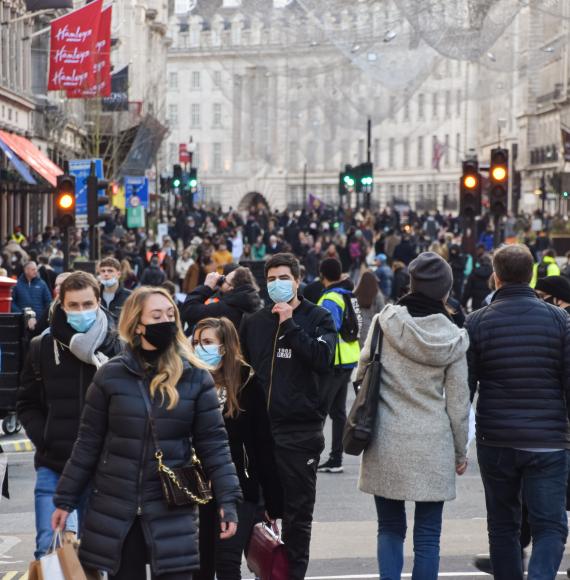
Image credit: iStock