
The UK Covid-19 Inquiry has concluded that thousands of care home residents and staff were failed during the early stages of the pandemic, with inadequate planning, delayed protective measures and devastating consequences for those living and working in adult social care.
In her sixth report, examining the impact of Covid-19 on adult social care across England, Scotland, Wales and Northern Ireland, the Chair of the UK Covid-19 Inquiry, Baroness Heather Hallett, found that the sector received insufficient protection at the point it was needed most.
The report, which forms part of Module 6 of the Inquiry’s work, highlights how pre-pandemic planning failed to account adequately for the specific needs of adult social care. As a result, governments across the UK were forced to make critical decisions without the necessary information about care services, workforce capacity and resident vulnerability.
More than 43,000 deaths involving Covid-19 were recorded in care homes between March 2020 and July 2022, with the Inquiry concluding that action to protect care users and staff came too late.
The report states that governments were aware before the pandemic that care home residents were particularly vulnerable to respiratory viruses. Despite this knowledge, care providers were not prioritised as Covid-19 spread rapidly through communities.
One of the Inquiry’s most significant findings challenges the assertion that a “protective ring” was placed around care homes from the outset of the pandemic. Baroness Hallett states that this claim was not supported by the evidence presented.
The Inquiry found that insufficient action was taken between March and mid-April 2020 to safeguard people living and working in care settings. While the decision to rapidly discharge patients from hospitals was taken to ensure NHS capacity was available for an expected surge in cases, limited testing capability meant healthcare providers often had no way of knowing whether discharged patients were carrying the virus.
Although isolation of discharged residents represented one of the few available protective measures at the time, guidance in England, Wales and Northern Ireland initially failed to recommend this approach.
The report describes this omission as a significant failing during a critical period of the response.
Lasting Impact of Visiting Restrictions
The Inquiry also examined the emotional and psychological effects of visiting restrictions introduced across care settings.
Many residents spent months separated from family and friends as strict controls were implemented to limit infection risks. For some, this meant being unable to spend precious final moments with loved ones.
The report concludes that restrictions caused profound and enduring harm, particularly for residents living with dementia and other complex cognitive conditions.
Baroness Hallett, Chair of the UK Covid-19 Inquiry said:
“Many millions of people across the UK receive adult social care. This includes older people, people with dementia and people living with physical and learning disabilities. For them and the people who dedicate themselves to providing their care, the pandemic totally disrupted their daily lives and had a devastating impact.
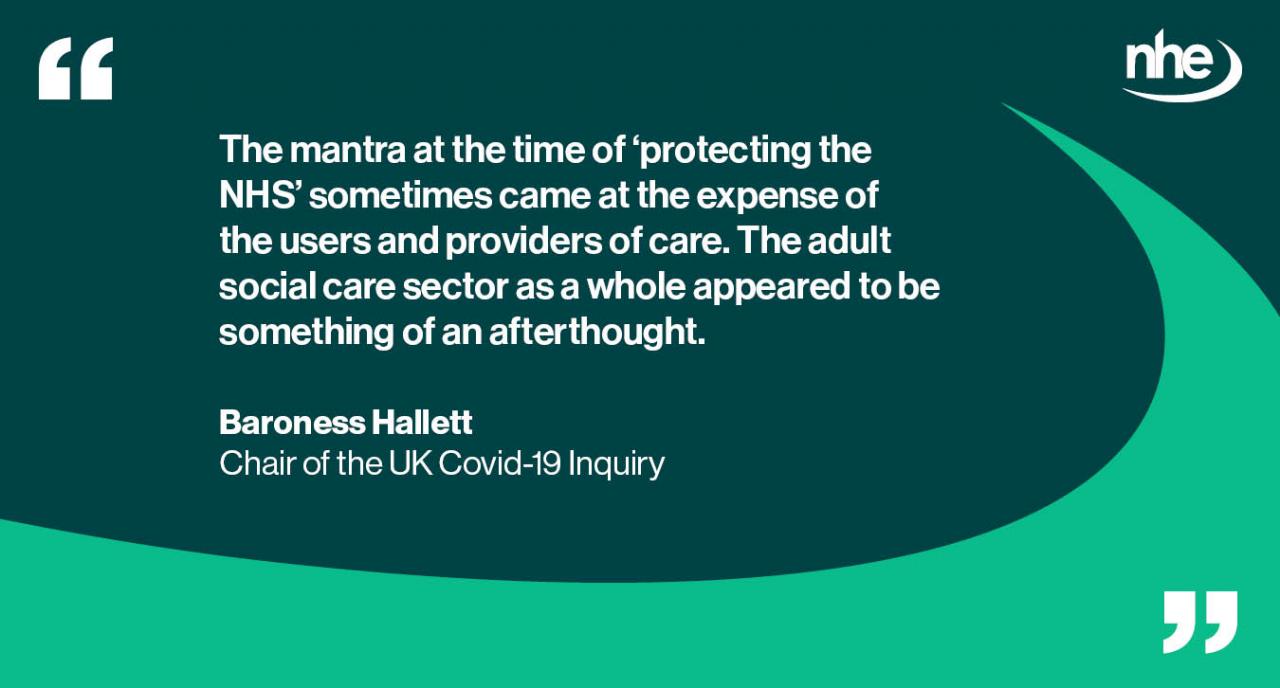
“At the critical early stages of the pandemic, not enough was done to protect those living and working in care homes. The mantra at the time of ‘protecting the NHS’ sometimes came at the expense of the users and providers of care. The adult social care sector as a whole appeared to be something of an afterthought.
“The profound isolation and sense of abandonment felt by residents as a result of the visiting restrictions resulted in immense emotional harm. Most distressingly, some people were not permitted to be with their dying loved ones. Many remain wracked by a guilt that they do not deserve to carry.
“During the pandemic, the action taken by the UK government and devolved administrations to try and protect workers and users of adult social care came too late. The failures were the direct result of an absence of proper pandemic planning for the adult social care sector. It underlines why my recommendations in this report must be acted upon now before the next pandemic strikes.”
The report paints a stark picture of the pressures faced by the social care workforce during the pandemic.
At least 1.5 million people working across care homes and domiciliary care services continued delivering essential support despite heightened personal risk. However, widespread shortages of personal protective equipment left many staff improvising with inadequate alternatives.
The Inquiry heard evidence of care workers relying on waterproof festival ponchos, painters’ overalls, bin bags and homemade equipment because appropriate PPE was unavailable.
Baroness Hallett describes these circumstances as “wholly unacceptable”, concluding that staff were often left without the protection they needed. While acknowledging that PPE shortages were experienced globally, the report argues that stronger preparedness planning could have significantly improved availability.
The Inquiry also highlighted widespread burnout across the sector, with many workers ultimately leaving care roles altogether. Meanwhile, support mechanisms for unpaid carers, who provided increasingly complex care for longer periods during lockdowns, were judged to have arrived too late.
According to the report, the pandemic exposed long-standing weaknesses within adult social care while reinforcing concerns that the sector remains undervalued and under-recognised.
The report revisits concerns surrounding the use of Do Not Attempt Cardiopulmonary Resuscitation (DNACPR) decisions in adult social care settings.
Echoing findings from the Inquiry’s Module 3 investigation, Baroness Hallett notes evidence suggesting some DNACPR decisions were made without appropriate consultation or were influenced by factors including age, disability or underlying health conditions.
While the Inquiry found no evidence of a national policy promoting blanket DNACPR decisions, it recommends mandatory end-of-life care training for health and social care professionals to improve the quality and sensitivity of these conversations.
The report makes eight key recommendations aimed at strengthening protection for adult social care during future public health emergencies:
- Improve pandemic preparedness structures, roles and responsibilities.
- Strengthen planning for the safe isolation of care home residents.
- Develop financial support schemes that can be rapidly deployed to support staff self-isolation and reduce workforce movement between settings.
- Publish clear guidance on visiting restrictions.
- Maintain inspection and oversight arrangements during future pandemics, including on-site inspections where possible.
- Improve the collection and reporting of adult social care mortality data.
- Introduce mandatory end-of-life care training for relevant health and social care staff.
- Establish a voluntary social care workforce register in England, bringing the nation into line with arrangements already operating in Scotland, Wales and Northern Ireland.
The Inquiry concludes that many of the challenges experienced by care providers, care workers, residents and families can be traced back to shortcomings in pre-pandemic planning.
Recommendations from Exercise Cygnus in 2016 identified the need to assess social care resilience and surge capacity, but much of this work remained incomplete when Covid-19 arrived.
Baroness Hallett warns that governments must now act on the Inquiry’s recommendations to ensure the mistakes experienced by care settings during Covid-19 are not repeated in future health emergencies.
Image credit: iStock