


Long waits, staff shortages and widening inequalities are putting patients at risk across England’s mental health system, according to the Care Quality Commission’s annual report on the use of the Mental Health Act.
The Monitoring the Mental Health Act 2024/2025 report draws on interviews with more than 3,000 patients and over 700 family members and carers, highlighting ongoing problems with access, safety and consistency of care. While many staff were praised for their compassion and commitment, the findings reveal a mental health sector under significant pressure.
The CQC found that increasing demand for mental health services, combined with higher thresholds for admission, is contributing to long waits for care. The regulator warns that delays can lead to people becoming more unwell, increasing the likelihood of detention under the Mental Health Act.
The report highlights a continued and concerning rise in out‑of‑area placements, despite a national commitment to end the practice by March 2021. Patients are still being sent far from home due to a lack of local beds, making it harder for families to visit and for services to provide continuity of care.
Some patients faced inappropriate environments, including:
- Children placed on adult wards
- People held far from home
- Individuals experiencing unnecessarily high levels of restriction
While some wards were found to be clean and therapeutic, others were described as noisy, dirty or unsafe, with one parent reporting “blood on the walls” and a “disgusting” toilet.
The report highlights stark inequalities:
- People in deprived areas are 3.6 times more likely to be detained under the Mental Health Act than those in the least deprived areas.
- Black people are detained at four times the rate of white people.
Despite this, the CQC found that in 51% of services visited, staff had not received training on racial inequalities. Similarly, during 103 visits between January and March 2025, three‑quarters of services reported staff were unaware of the Patient and Carer Race Equality Framework – a mandatory tool for tackling racism and improving outcomes.
Nearly 1 in 10 roles in NHS mental health trusts were vacant as of March 2025. Reliance on agency staff and a lack of continuity mean staff often struggle to build therapeutic relationships – a cornerstone of effective mental health care.
Consequences include:
- Staff reduced capacity to safely de‑escalate crises
- Higher levels of burnout
- Patients reporting feeling unsafe due to low staffing
Some patients also reported that staff lacked the skills to support autistic people or those with learning disabilities, leading to experiences described as undignified or dismissive.
The regulator’s report features the story of Emily, a former patient detained under the Mental Health Act. She and her family were unaware of her rights, and she recalls being left alone for weeks without clear communication about her care.
Although she has since improved following therapy, Emily believes that timely community support could have prevented her detention altogether.
The CQC is calling for urgent, system‑wide improvements to ensure people do not spend unnecessary months, or even years, in hospital due to pressures, shortages and failures in community support.
Interim Chief Inspector of Mental Health at the Care Quality Commission, Chris Dzikiti, commented:
“It’s deeply disappointing to again be highlighting the same issues of overworked healthcare workers, unequal experiences, people being placed in inappropriate environments, and ultimately, people struggling to get the care they need.
“Many people who are detained under the Mental Health Act have exhausted all other avenues of care, yet they still face long waits, with families sometimes forced to supervise them constantly while they wait.
“For Black people, autistic people, and people with a learning disability, the barriers to appropriate care are even greater.
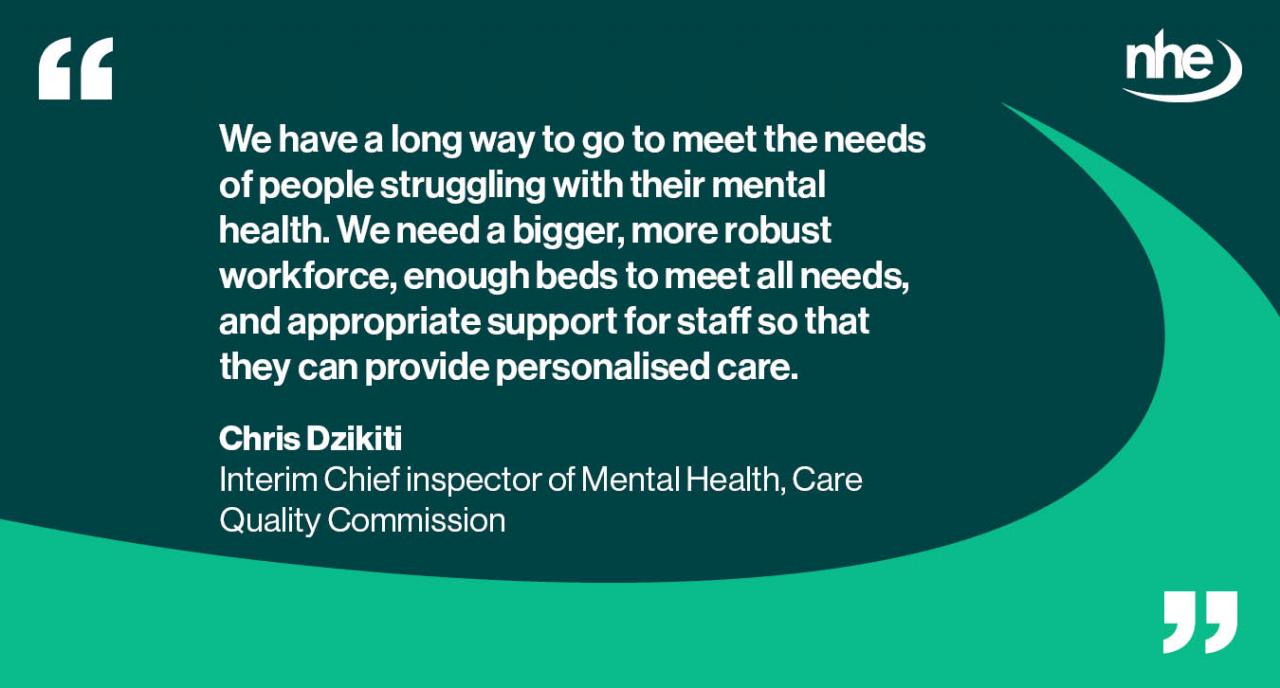
“We have a long way to go to meet the needs of people struggling with their mental health. We need a bigger, more robust workforce, enough beds to meet all needs, and appropriate support for staff so that they can provide personalised care.
“However, I do want to thank the countless hard-working people in mental health care who provide person-centred and compassionate care in these challenging circumstances.
“We welcome the revised Mental Health Act and its ambitions to improve patient autonomy, give patients a greater role in decision-making and ultimately to improve the experience of people in mental health care. We will work closely with the government and others to support these aims.”
The regulator argues that a coordinated national effort is essential to address longstanding inequalities, improve staff capacity, and ensure that all patients receive safe, dignified and compassionate care
Image credit: iStock