

The Medicines and Healthcare products Regulatory Agency (MHRA) has granted marketing authorisation for rilzabrutinib (Wayrilz), offering a new treatment option for adults living with immune thrombocytopenia (ITP) who have not responded adequately to previous therapies.
ITP is a rare autoimmune disorder in which the body mistakenly attacks and destroys its own platelets. This reduction in platelet levels can lead to persistent fatigue and an increased risk of bleeding – sometimes severe – due to the blood’s reduced ability to clot.
A targeted mechanism of action
Rilzabrutinib works by inhibiting Bruton’s tyrosine kinase (BTK), a protein involved in immune system signalling pathways. By blocking BTK activity, the medicine helps slow the immune-mediated destruction of platelets, allowing platelet counts to recover and, in turn, reducing bleeding risk.
The drug is administered orally in tablet form, taken twice daily – an approach that may offer practical advantages for patients compared with more invasive therapies.
Evidence from pivotal Phase 3 trial
The MHRA’s decision is supported by data from a pivotal Phase 3 clinical study involving 202 patients with ITP whose previous treatments had failed to produce a sufficient response. After 24 weeks 23% of patients treated with rilzabrutinib achieved a stable and clinically meaningful platelet count, with none of the patients receiving placebo reaching this outcome.
These results highlight a clear therapeutic benefit in a population with limited treatment options.
Safety profile and monitoring
As with any new therapy, safety remains a central consideration. The most frequently reported side effects – affecting more than one in ten patients – include:
- Diarrhoea
- Upper respiratory tract infections (nose and throat)
- Nausea
- Headache
- Abdominal pain
- Joint pain
The MHRA has confirmed that it will continue to monitor the medicine closely as it is rolled out in clinical practice.
Regulatory perspective
Julian Beach, MHRA Executive Director for Healthcare Quality and Access, reinforced the agency’s position on balancing innovation with patient safety:
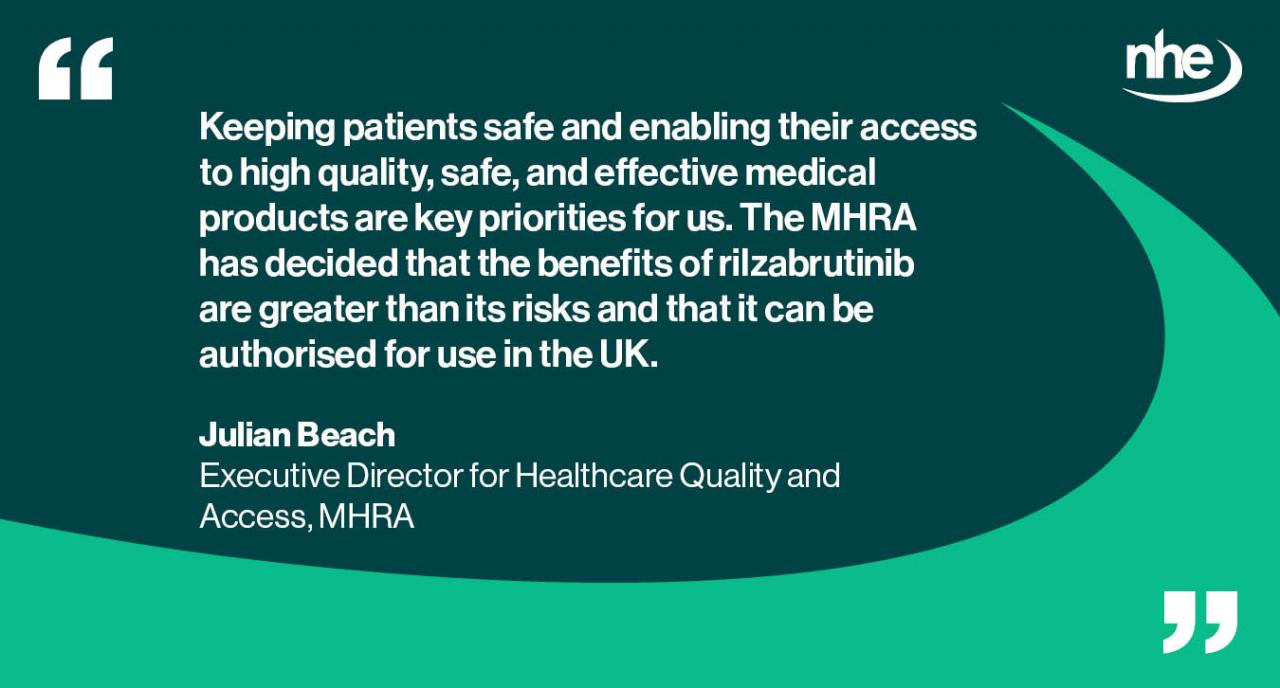
“Keeping patients safe and enabling their access to high quality, safe, and effective medical products are key priorities for us.
“The MHRA has decided that the benefits of rilzabrutinib are greater than its risks and that it can be authorised for use in the UK.
“As with all products, we will keep the safety and effectiveness of rilzabrutinib under close review.”
What this means for UK healthcare professionals
For clinicians and NHS decision-makers, the approval of rilzabrutinib introduces:
- A novel BTK-targeting therapy for difficult-to-treat ITP cases
- An oral treatment option, potentially reducing reliance on hospital-based interventions
- A new pathway for improving platelet stability, particularly where other therapies have failed
As pressure grows to improve outcomes for rare disease patients, this approval represents a meaningful addition to the therapeutic toolkit.
Image credit: iStock