

Patients across England could be seen more quickly this winter as hospitals increasingly rely on artificial intelligence to predict when A&E departments will face the most pressure. The technology, known as the A&E demand forecasting tool, is now available to all NHS Trusts and is already being used by 50 NHS organisations nationwide.
The tool forms part of the government’s push to modernise public services, harness emerging technologies and support the NHS during a winter marked by record flu cases and seasonal strains such as icy falls and festive illnesses.
The AI system analyses a wide range of real‑time and historical data – including Met Office temperature forecasts, hospital admission patterns and day‑of‑week trends – to predict surges in demand. Hospitals can then use this insight to plan staffing, shift patterns, bed capacity, and urgent treatment resources more effectively.
For NHS teams, this means fewer last‑minute pressures and clearer forward planning. For patients, it is expected to lead to shorter waiting times during peak periods, ensuring timely access to emergency care.
This winter, the NHS is dealing with an early peak in flu cases, adding further pressure to an already stretched system. More than 18 million flu vaccines have been delivered this autumn – several hundred thousand more than the same point last year – helping protect vulnerable groups. As the AI tool learns from ongoing seasonal data, it will continue to improve its accuracy, highlighting potential spikes in pressure before they occur.
Early feedback from NHS managers using the system has been strongly positive. Leaders from organisations including NHS Coventry and Warwickshire Integrated Care Board and NHS Bedfordshire, Luton, and Milton Keynes Integrated Care Board report that the tool has already helped improve decision‑making around capacity and staffing, enabling patients to move through the system more efficiently.
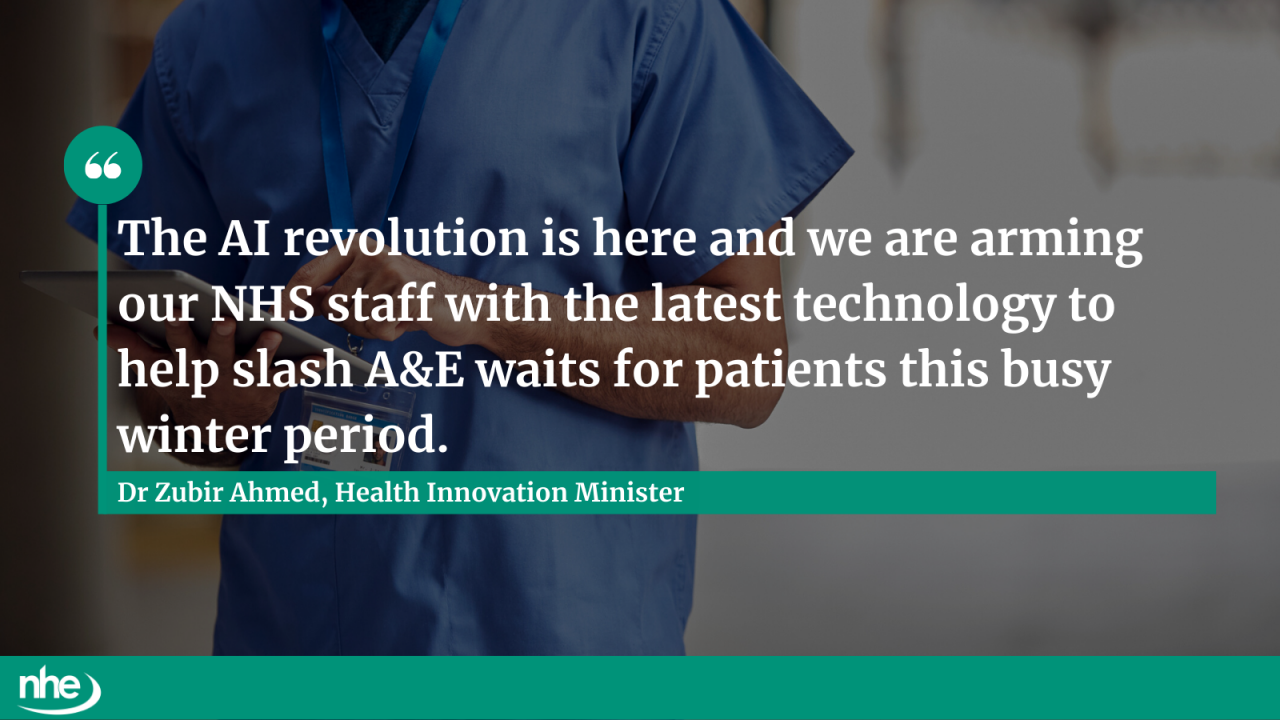
Dr Zubir Ahmed, Health Innovation Minister, said:
“The AI revolution is here and we are arming our NHS staff with the latest technology to help slash A&E waits for patients this busy winter period.
“Innovations like these will help hospitals manage winter pressure and prioritise resources over the coming months as we continue to battle a tidal wave of flu.
“This is part of our 10 Year Health Plan to shift healthcare from analogue to digital as we build an NHS that is fit for the future.”
The A&E forecasting tool sits within the AI Exemplars programme, a flagship initiative designed to bring modern AI solutions into everyday public services. The programme is already improving delivery across a range of sectors, including:
Education
- The Education Content Store: A secure pool of curriculum materials, anonymised assessments and lesson plans that AI companies can use to train tools which generate accurate, high‑quality educational content.
Health
- AI Diagnostics: Tools that help clinicians interpret scans and spot conditions like lung cancer sooner, helping reduce diagnostic backlogs.
- AI‑Assisted Discharge Summaries: Technology that drafts discharge documents to speed up the process of getting patients home, while clinicians retain full control and sign‑off.
Public Services
- GOV.UK Chat: An AI‑powered service that provides everyday language answers based on official GOV.UK content, giving users quick, reliable information.
The adoption of AI in A&E departments reflects the government’s wider commitment to building a modern, resilient NHS able to withstand winter pressures and meet long‑term demand. As the tool continues to evolve, officials expect it will play a key role in ensuring patients receive faster, safer, and more efficient emergency care.
Image credit: iStock