A patient from Wirral has become the first person in the world to receive a groundbreaking personalised cancer vaccine designed to treat the most common form of lung cancer.
Clinicians and researchers at Chris Jones's treatment centre, The Clatterbridge Cancer Centre, are working alongside the University of Liverpool and the Liverpool Clinical Trials Centre on an early-stage clinical trial investigating the bespoke vaccine. The treatment has been tailored to target the specific genetic mutations within Chris's tumour, offering a highly personalised approach to cancer care.
Chris, from Hoylake, is living with advanced non-small cell lung cancer that has only partially responded to conventional immunotherapy. Researchers hope the vaccine will help strengthen her immune system, enabling it to better identify and destroy cancer cells throughout her body, potentially extending the benefits of her current treatment.
The innovative vaccine has been developed using advanced computational technology from biopharmaceutical company myNEO, which identifies tumour-specific targets most likely to trigger a powerful immune response. These targets are then incorporated into a personalised vaccine using a pioneering manufacturing process known as 'doggybone DNA' (dbDNA™).
Unlike traditional DNA production methods, dbDNA™ is manufactured using a cell-free process that enables personalised vaccines to be produced more quickly and at lower cost. The technology forms part of the portfolio of UK-based biotechnology company Touchlight, which specialises in synthetic DNA manufacturing and uses enzymes to efficiently amplify DNA in laboratory conditions.
Researchers at Clatterbridge believe the use of dbDNA™ could play a crucial role in making personalised cancer vaccines more scalable and accessible in the future. The collaboration between Clatterbridge and Touchlight is expected to provide important clinical evidence supporting the technology's potential benefits.
The NEOVACC Phase I trial will recruit 10 patients with advanced non-small cell lung cancer. Its primary objectives are to assess safety and determine whether the vaccine can generate an effective immune response against the disease.
Around 50,000 people in the UK are diagnosed with non-small cell lung cancer each year, while globally there are approximately two million cases annually, making it the world's third most common cancer.
Chris was referred for further investigation by her GP after experiencing a persistent cough and increasing breathlessness. With both her father and grandfather having died from lung cancer, the diagnosis confirmed her worst fears.
After standard immunotherapy failed to halt the progression of the disease, Chris was offered the opportunity to participate in the clinical trial.
Despite her ongoing treatment, Chris continues to run the popular Hoylake gelato and coffee shop Churn & Chill alongside her daughter, Phoebe. Her other daughter, Grace, works as a firefighter.
Chris's family has already endured the devastating impact of cancer. Her eldest daughter, Alex, died from breast cancer in 2016 at the age of 26, three years after being diagnosed. During her illness, Alex dedicated herself to raising money for cancer charities and worked closely with the CoppaFeel! campaign to promote awareness of self-examination and early diagnosis.
The NEOVACC study brings together specialists from a wide range of disciplines, including oncologists, immunologists, genetic scientists, clinical trial experts, NHS teams and industry partners. The research is supported by a £2.66 million grant from the Medical Research Council's Development Pathway Funding Scheme.
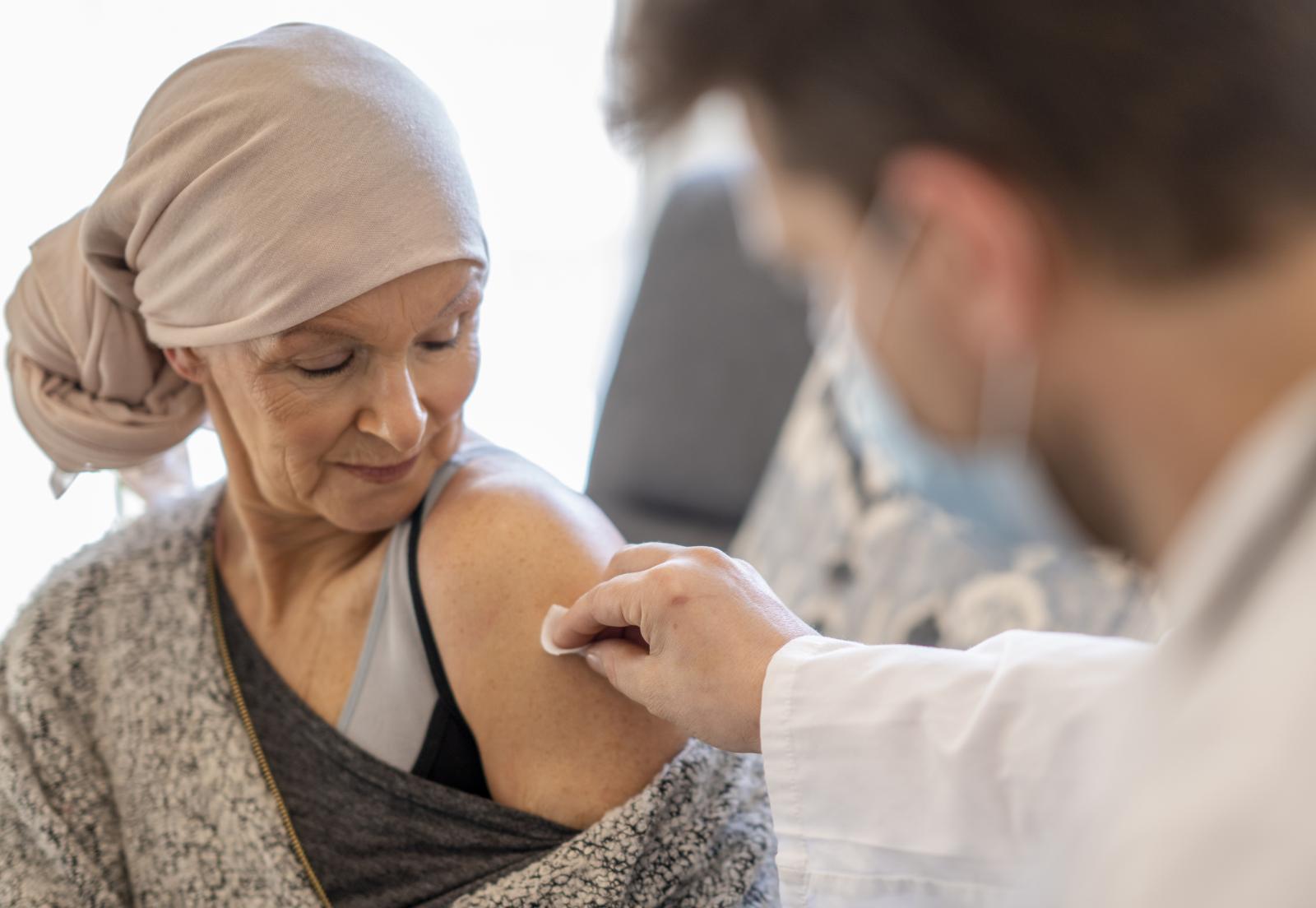
Chris received her first vaccine dose at Clatterbridge Cancer Centre Liverpool using the PharmaJet Stratis needle-free injection system. The technology is designed to improve DNA vaccine delivery directly into the muscle, enhancing immune response. She will continue to receive additional vaccine doses over the coming months alongside her existing immunotherapy treatment.
The trial is led by Professor Christian Ottensmeier, Consultant Oncologist at Clatterbridge, and Professor Natalia Savelyeva, both from the University of Liverpool's Institute of Systems, Molecular and Integrative Biology.
Chief Investigator Prof Ottensmeier said:
“This personalised approach could offer hope to those for whom standard immunotherapy has not fully worked, by helping the immune system recognise and fight the parts of the tumour that have previously evaded detection. I hope this research will contribute to new ways of thinking about cancer vaccine use in advanced lung cancer.
“We are excited to be using ‘doggybone’ technology in the creation of this vaccine, which has the potential to be a gamechanger in reducing the speed and cost of production of these important therapies.”
NHS Blood and Transplant provides the ‘fill-finish’ part of the therapy production, through the NHSBT Clinical Biotechnology Centre in Bristol. NHSBT also collect the patient’s cells for analysis. The collection is done at the patient’s bedside by one of NHSBT’s Therapeutic Apheresis Services teams.
Image credit: iStock