


The Health Services Safety Investigations Body has raised concerns about patient safety across regional care pathways, highlighting gaps in accountability, oversight and data sharing between NHS organisations.
In its latest report, HSSIB shares insights from a pilot of a new rapid investigation process, which examined a redesigned regional care pathway. The pathway had been developed with the intention of reducing health inequalities, improving outcomes and ensuring more efficient use of NHS resources.
However, the investigation found significant challenges in how the pathway was understood and implemented in practice. The integrated care board (ICB) and partner NHS trusts lacked a shared understanding of how the pathway should operate, leading to inconsistencies in delivery and management of patient safety.
The report found that responsibilities across organisations were not always clearly defined. Risks were not consistently shared between partners, and oversight arrangements were often limited. As a result, the ICB’s ability to take a proactive, system-level approach to managing patient safety was weakened.
HSSIB also identified variation in data collection practices across organisations, alongside limited information sharing. This made it difficult for any one organisation to gain a comprehensive view of how the pathway was performing or where patient safety risks were emerging.
Without a consistent approach to data and coordination, the investigation found that risks could go unidentified or unmanaged, particularly where care spans multiple providers. The findings suggest that while integrated care pathways aim to improve outcomes, they can introduce new safety challenges if governance and communication are not robust.
Deinniol Owens, Deputy Director of Investigations at HSSIB, said:
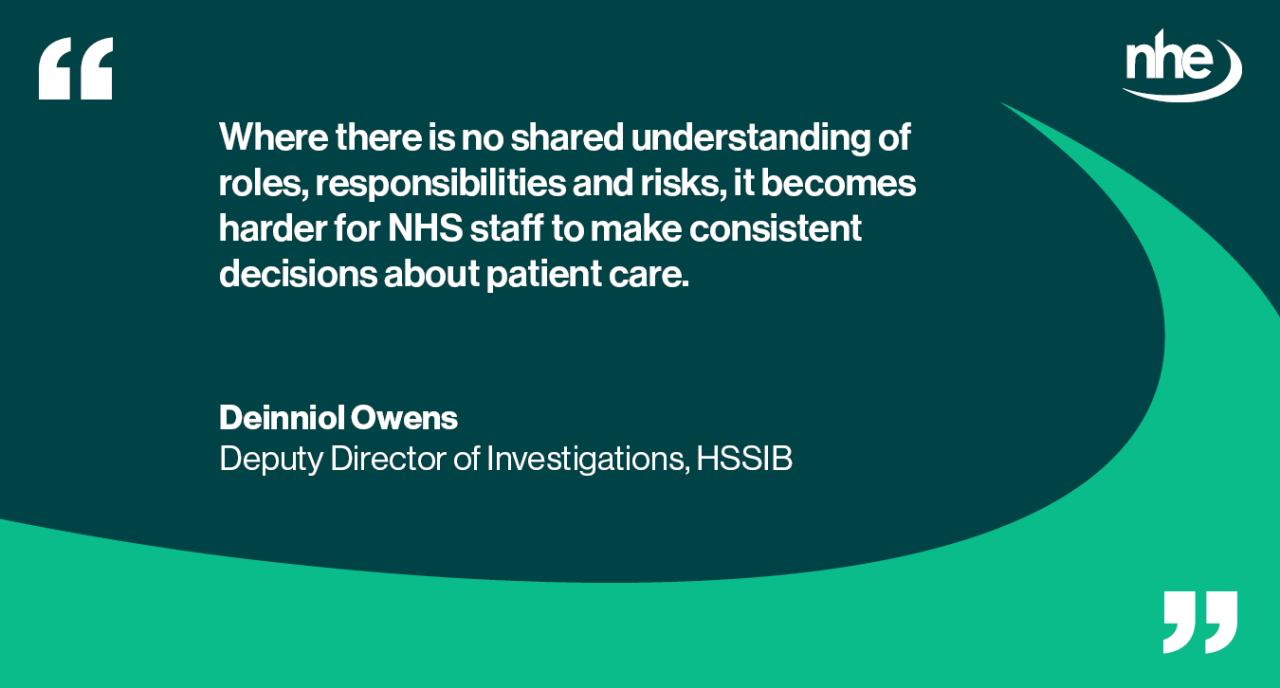
“Patient safety should be at the forefront of decision making and proactively monitored across regional care pathways. Where there is no shared understanding of roles, responsibilities and risks, it becomes harder for NHS staff to make consistent decisions about patient care.
“As our previous work on safety management systems reinforces, if organisations face challenges in coordinating activity to support patient care, accountability and responsibility can become misaligned. This leads to gaps in the oversight of safety and risks to patients and NHS staff. We are grateful to the organisations involved in the pilot for supporting us to test this new approach and share this important safety learning.”
HSSIB is urging NHS leaders to take action to address these issues by:
- Clarifying roles, responsibilities and accountability across organisations
- Improving data sharing and consistency in data collection
- Strengthening oversight arrangements at a system level
- Supporting a more coordinated, cross-organisational approach to patient safety
The findings reinforce the growing importance of integrated governance frameworks within ICSs, particularly as collaboration across organisational boundaries becomes the norm in delivering care.
Image credit: iStock