

NHS trusts are facing renewed pressure to scrap restrictions on the number of absorbent continence products supplied to patients after ministers restated that continence care should be determined by clinical need rather than arbitrary limits.
The Department of Health and Social Care has confirmed that NHS services are expected to follow guidance from the National Institute for Health and Care Excellence and professional standards set by the Royal College of Nursing when assessing both the type and quantity of continence products required by patients.
The clarification came in response to a written parliamentary question from Bedford Labour MP Mohammad Yasin, who asked ministers what action was being taken to ensure NHS trusts comply with national guidance when deciding which continence products are appropriate for patients.
Mohammad Yasin, MP for Bedford and a member of the Adult Social Care All-Party Parliamentary Group, welcomed the Government’s position and called for consistent implementation across the NHS.
Yasin said:
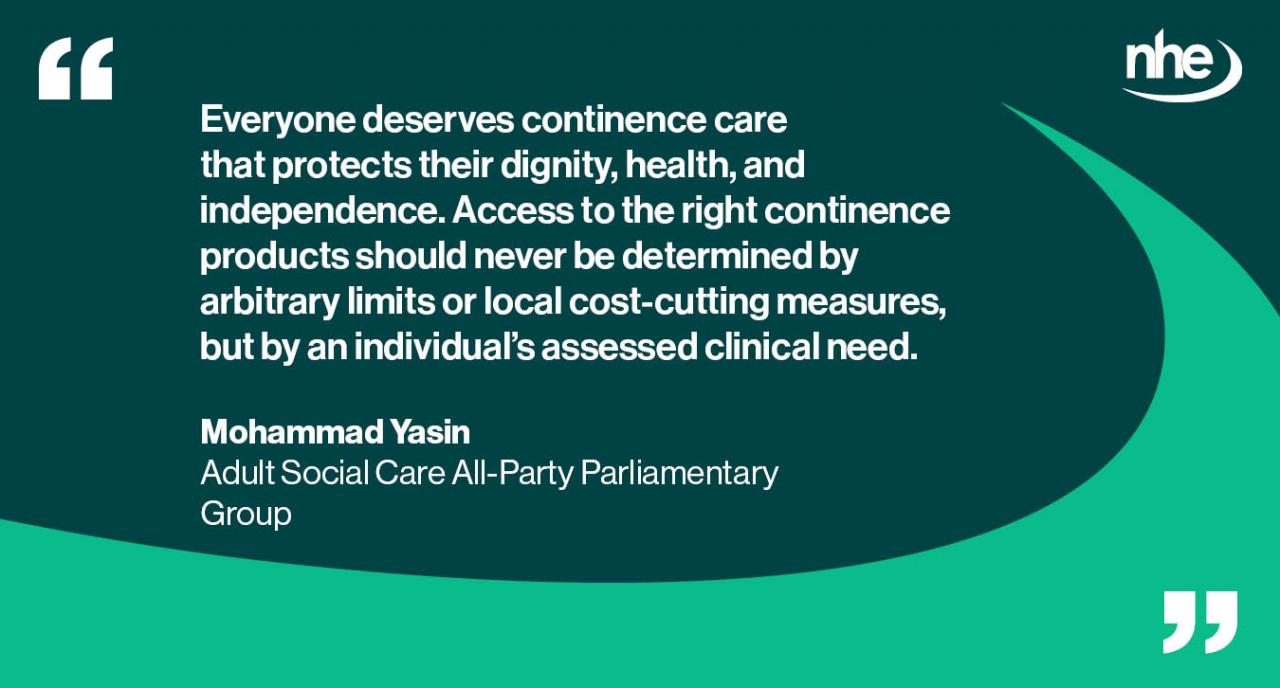
“Everyone deserves continence care that protects their dignity, health, and independence. Access to the right continence products should never be determined by arbitrary limits or local cost-cutting measures, but by an individual’s assessed clinical need.
“The Government’s reaffirmation of this principle, in line with NICE guidance and Royal College of Nursing standards, is a welcome step. Continence care is a basic right. This principle must now be applied consistently across every NHS trust so that no one is left without the support they need simply because of where they live.”
The statement follows growing concern over postcode variations in continence care and comes shortly after the launch of the End the Pad Gap campaign.
The campaign, which is supported by organisations including the Royal College of Nursing, Prostate Cancer UK, Bladder & Bowel UK, Dementia Carers Count and hygiene and health company Essity, argues that many people living with incontinence are being denied sufficient products to remain dry, healthy and independent.
Freedom of Information data cited by campaign organisers found that 53% of 110 NHS trusts surveyed imposed limits on continence product provision. Of those trusts, 34% restricted patients to three products per day, while the remainder capped supply at four products daily.
Campaigners argue that these restrictions conflict with existing national guidance. NICE guidance states that continence products should be provided according to individual need, while patients should receive sufficient pads to meet their requirements. The guidance also makes clear that "it is inappropriate to limit the number of pads given."
Further professional guidance from the Association for Continence Professionals and the Royal College of Nursing states that the number of absorbent continence products issued each day “must meet assessed clinical need”.
For patients, inadequate continence care can have a significant impact on quality of life. Insufficient access to products can lead to discomfort, embarrassment, sleep disruption, skin damage and a loss of independence.
The consequences also extend to families and carers, many of whom are forced to shoulder additional physical, financial and emotional burdens when adequate support is not available.
Campaigners are now urging NHS trusts to review local policies and ensure continence product provision aligns with national clinical guidance, rather than budget-led restrictions.
Image credit: iStock