

The Medicines and Healthcare products Regulatory Agency has launched a new Women’s Health Programme aimed at improving evidence on how medicines and medical devices affect women, addressing long-standing gaps in research that have left many female patients underserved.
The initiative comes amid growing concern that women remain underrepresented in clinical research, despite accounting for 51% of the UK population. Health leaders say the lack of robust evidence has limited understanding of how the benefits and risks of medicines and medical technologies can differ for women, particularly during pregnancy, breastfeeding and across key stages of reproductive health.
Analysis conducted by the MHRA of 4,616 UK clinical trial applications submitted between 2019 and 2023 revealed significant gaps in participation. Pregnant women were included in just 1.1% of trials, while breastfeeding women featured in only 0.6%.
The new programme will bring together patients, researchers, healthcare professionals and industry partners to strengthen the evidence base for medicines and medical devices while maintaining established standards of safety, quality and effectiveness.
Women’s health specialists have long highlighted the challenges created by limited clinical data, particularly in areas such as pregnancy, menopause, reproductive health and conditions that affect women differently from men. The MHRA believes improved research and better data will support safer prescribing decisions, accelerate innovation and lead to more effective treatments.
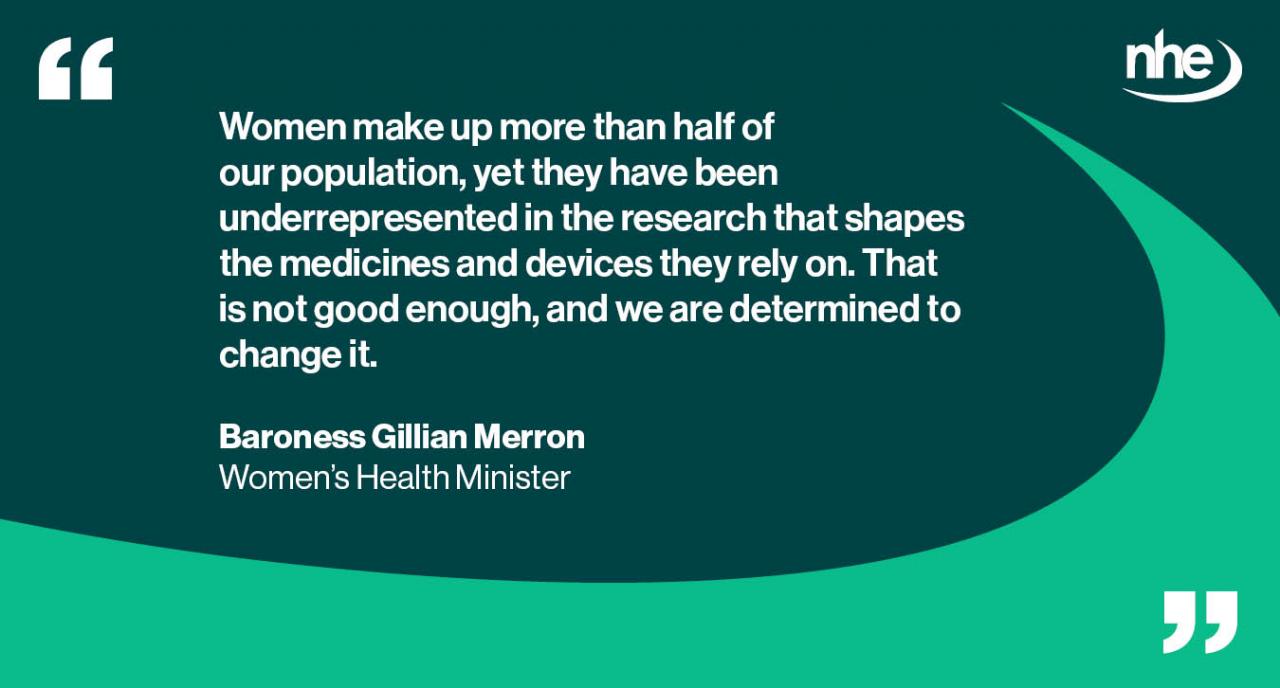
Women’s Health Minister, Baroness Gillian Merron, said:
“For too long, women’s health has been overlooked. Women make up more than half of our population, yet they have been underrepresented in the research that shapes the medicines and devices they rely on. That is not good enough, and we are determined to change it.
“This new programme is a welcome step. Together with our renewed Women’s Health Strategy, it will mean better evidence, better treatments, and a health system that listens to women and works for them.”
The programme forms part of the MHRA’s wider commitment to tackling health inequalities through its recently launched 2030 Strategy and supports the Government’s broader ambitions under the renewed Women’s Health Strategy for England, alongside corresponding programmes in Scotland, Wales and Northern Ireland.
Officials also see women’s health as a major area of economic and technological opportunity. The UK’s rapidly growing FemTech sector is now worth nearly £300 million annually, with innovators developing products and digital technologies across fertility, menopause care, reproductive health, chronic disease management and healthy ageing.
By engaging researchers and innovators earlier in the development process, the MHRA hopes to generate stronger evidence on sex-specific responses to medicines and devices, helping promising technologies reach patients faster while maintaining public confidence in regulation.
The programme has been shaped through extensive patient involvement, including engagement with the MHRA’s Patient and Public Community and focus groups delivered by the Patients Association. This collaborative approach aims to ensure future regulation is informed by the lived experiences of women across the healthcare system.
The announcement coincides with the inaugural DIA-MHRA Global Summit in London, taking place during London Life Sciences Week. The event brings together international regulators, industry leaders, researchers, clinicians and patient representatives to explore how global collaboration can accelerate innovation and improve patient access to new treatments and technologies.
For NHS leaders, healthcare providers and life sciences organisations, the programme signals a renewed focus on generating the evidence needed to improve outcomes for women while supporting innovation in one of healthcare's fastest-growing sectors.
Image credit: iStock