

Thousands of people at increased risk of oesophageal cancer could soon benefit from a quicker, less invasive test carried out in GP practices and community diagnostic centres, following new draft guidance from NICE.
The National Institute for Health and Care Excellence has recommended two capsule sponge technologies, Cytosponge and EndoSign, as options for detecting Barrett's oesophagus and oesophageal cancer in people with persistent gastro-oesophageal reflux disease (GORD), commonly known as acid reflux.
If approved in final guidance, the tests could transform how patients at risk of oesophageal cancer are assessed by reducing reliance on hospital-based endoscopy procedures and improving access to earlier diagnosis.
The recommendations represent the first guidance to be produced through the government's new National HealthTech Access Programme, an initiative designed to fast-track high-impact medical technologies into routine NHS use where evidence demonstrates patient benefit and value for the health service.
Earlier detection could save lives
Barrett's oesophagus affects an estimated 1% to 2% of adults and occurs when cells lining the lower oesophagus change, often as a result of long-term acid reflux. While most people with the condition will never develop cancer, it significantly increases the risk of oesophageal adenocarcinoma.
Oesophageal cancer remains one of the most difficult cancers to treat when diagnosed at a later stage, making earlier identification of cellular changes crucial to improving outcomes.
NICE's independent committee concluded that Cytosponge and EndoSign could be used both to identify Barrett's oesophagus in higher-risk patients and as part of ongoing surveillance programmes for people already diagnosed with the condition.
The committee also believes wider adoption could help alleviate mounting pressure on NHS endoscopy services, where demand continues to outstrip capacity in many parts of the country.
First technology assessed under new NHS access programme
The capsule sponge recommendations are the first to emerge from the National HealthTech Access Programme, which brings together NICE, the Department of Health and Social Care, NHS England, the Medicines and Healthcare products Regulatory Agency (MHRA) and the Office for Life Sciences.
The programme forms part of the government's 10-Year Health Plan and expands the technology appraisal system traditionally used for medicines to include selected medical devices, diagnostic technologies, digital tools and AI-enabled innovations.
If NICE issues final approval, eligible patients across England will have consistent access to the technology regardless of where they live, reducing regional variation in availability.
NICE Chief Executive Professor Jonathan Benger said:
“As the first technology to be considered through the National HealthTech Access Programme, capsule sponge tests mark an important step in identifying high-impact technologies that, when recommended by NICE, should be adopted consistently across the NHS so patients can benefit wherever they live.”
Professor Benger added:
“Oesophageal cancer is very difficult to treat when it is diagnosed at a later stage, so identifying people sooner is really important.
“For people with persistent acid reflux and other risk factors, there is an increased chance of developing Barrett’s oesophagus, which can increase their risk of oesophageal cancer.
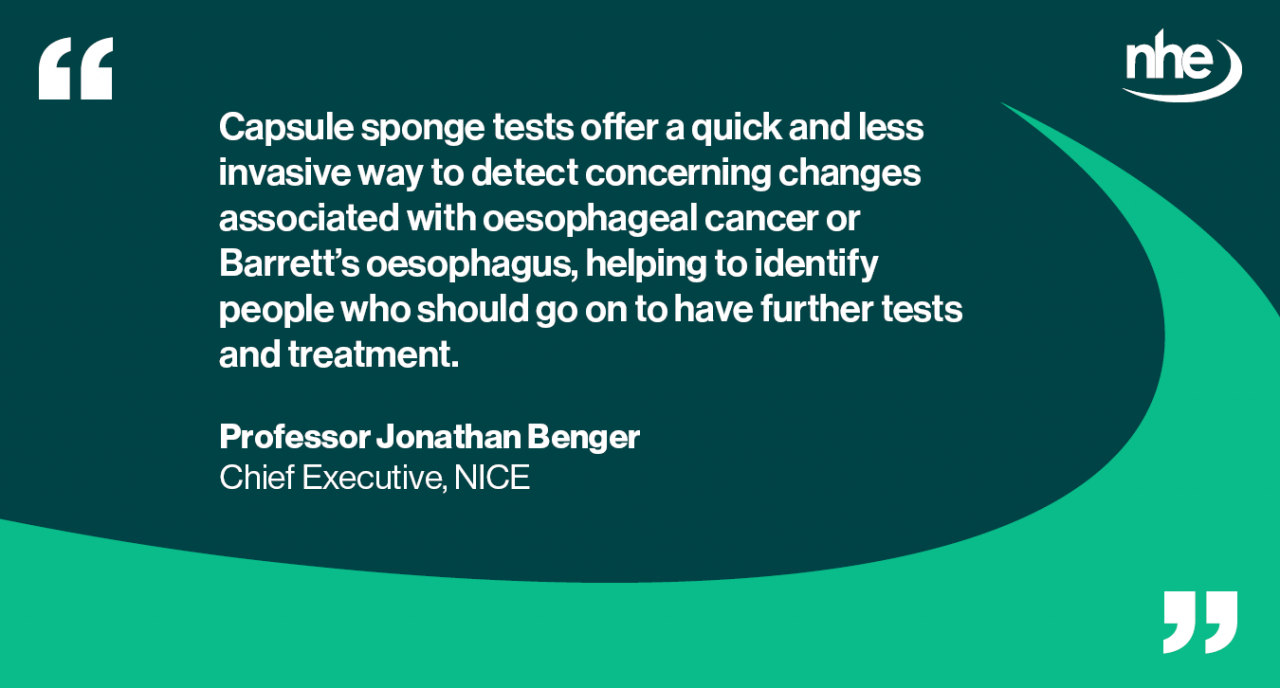
“Capsule sponge tests offer a quick and less invasive way to detect concerning changes associated with oesophageal cancer or Barrett’s oesophagus, helping to identify people who should go on to have further tests and treatment.
“This new technology has the potential to make testing easier for patients, while helping the NHS focus valuable endoscopy capacity on those who need it most.”
How the capsule sponge test works
The procedure is significantly less invasive than a traditional endoscopy.
Patients swallow a small capsule attached to a thread. After approximately seven minutes, the capsule dissolves in the stomach, releasing a sponge which expands naturally.
A healthcare professional then gently retrieves the sponge using the thread. As it is pulled through the oesophagus, the sponge collects cells from the lining of the food pipe. The sample is then analysed in a laboratory for cellular changes associated with Barrett's oesophagus or oesophageal cancer.
Patients whose results indicate possible abnormalities are referred for a diagnostic endoscopy to confirm findings and determine next steps.
Around 95% of patients successfully swallow the capsule, and the procedure can be carried out by a single trained healthcare professional. By comparison, an endoscopy typically requires an endoscopist and at least two nurses.
Patients favour less invasive option
The NICE committee heard evidence that many patients strongly prefer capsule sponge testing because it is quicker, less invasive and avoids some of the risks associated with endoscopy, including sedation-related complications, bleeding and accidental damage to the oesophagus.
While some patients experience temporary throat irritation or discomfort when the sponge is removed, serious adverse events are rare.
The committee noted that no diagnostic test is perfect, including endoscopy, and patients receiving a negative result should still be advised about symptoms and when to seek further medical assessment.
Development of oesophageal capsule sponge technology has received significant support from the National Institute for Health and Care Research (NIHR) and Cancer Research UK.
The technology was evaluated through the landmark BEST3 trial and is currently being examined further through the £7.6 million BEST4 screening trial, which includes the use of mobile screening units designed to bring testing directly into communities.
NICE is currently consulting on the draft recommendations before publishing final guidance.
Image credit: iStock