

The National Institute for Health and Care Research has awarded £5 million to five innovative research projects that aim to help the UK's health and social care system cut carbon emissions, reduce waste and deliver better value for patients and taxpayers.
The funding marks the first phase of a wider £25 million programme launched by the NIHR in late 2024. Running annually over five years, the initiative is designed to tackle critical evidence gaps and accelerate the development of sustainable solutions across health and social care.
The programme reflects growing recognition that environmental sustainability and operational efficiency are increasingly interconnected. By identifying and evaluating practical innovations, the research aims to support a more resilient health and care system while improving productivity and resource management.
The NIHR's long-term investment seeks to encourage researchers, healthcare organisations and care providers to develop evidence-based approaches that can help address some of the sector's most pressing sustainability challenges.
The programme focuses on four key priorities:
- Supporting decarbonisation across health and social care
- Reducing avoidable waste
- Improving the efficiency of resource use
- Strengthening long-term resilience across services
The first five projects selected for funding demonstrate the breadth of opportunities available to improve sustainability while maintaining high-quality care.
The Five Research Projects
1. Childbirth, Choice and Climate Change
This project will investigate how maternity services can reduce emissions linked to the use of gas and air during labour.
Researchers will develop national guidance and practical tools to help hospitals identify supply leaks, reduce clinical waste and lower emissions without limiting access to effective pain relief options.
The study highlights a significant opportunity for improvement. In December 2025 alone, emissions from gas and air use in NHS England were estimated to be equivalent to 12,622 tonnes of carbon dioxide.
Working closely with maternity professionals, patients and service leaders, the research team will explore practical ways to reduce environmental impact while maintaining patient choice and quality of care.
2. Including Carbon Emissions in Cost-Effectiveness Assessments to Reduce the Carbon Impact of Medicines
This study will examine how environmental impact can be incorporated into the way new medicines are assessed for use within the NHS.
Researchers will explore how the National Institute for Health and Care Excellence (NICE) could include carbon emissions alongside traditional measures of clinical and economic value when evaluating treatments.
The project aims to create a framework that incentivises pharmaceutical companies to reduce waste, lower emissions and deliver greater value for money.
3. PharmaBag: A Sustainable Packaging System to Reduce Pharmaceutical Waste
The PharmaBag project is developing environmentally-friendly packaging that could allow unopened, high-cost medicines, including cancer treatments, to be safely reused.
By enabling medicines to remain secure and suitable for redistribution, the initiative aims to tackle unnecessary waste, help prevent medicine shortages and improve medicines management across the NHS.
If successful, the approach could deliver significant financial savings while supporting sustainability targets.
4. Assessing the Impact of Virtual Wards on Decarbonising Acute Care
Virtual wards have become an increasingly important part of healthcare delivery, allowing patients with acute conditions to receive treatment and monitoring at home through digital technology.
This research will evaluate how virtual wards contribute to reducing carbon emissions while improving service efficiency and patient outcomes.
The project aims to develop sustainable care pathways that reduce pressure on hospitals, make better use of available resources and support patient recovery outside traditional inpatient settings.
5. Social-Decarbon: Identifying and Modelling More Efficient Social Care Services
Focused on adult social care, this study will investigate ways to improve energy efficiency and reduce emissions across the sector.
Researchers will identify care models that shift support away from hospitals and towards homes and communities, helping organisations deliver more sustainable and cost-effective services.
The project will also provide decision-making tools that enable managers to model the financial and operational impact of different care approaches before implementation.
Dr Sophia Lentzos, Head of Climate, Health and Sustainability at the NIHR, commented:
“To see the first studies we've funded as part of this initiative getting underway marks a hugely important milestone. Our 5-year programme will fund the research and innovation needed to deliver resource-efficient, equitable healthcare that improves the health and wellbeing of patients.
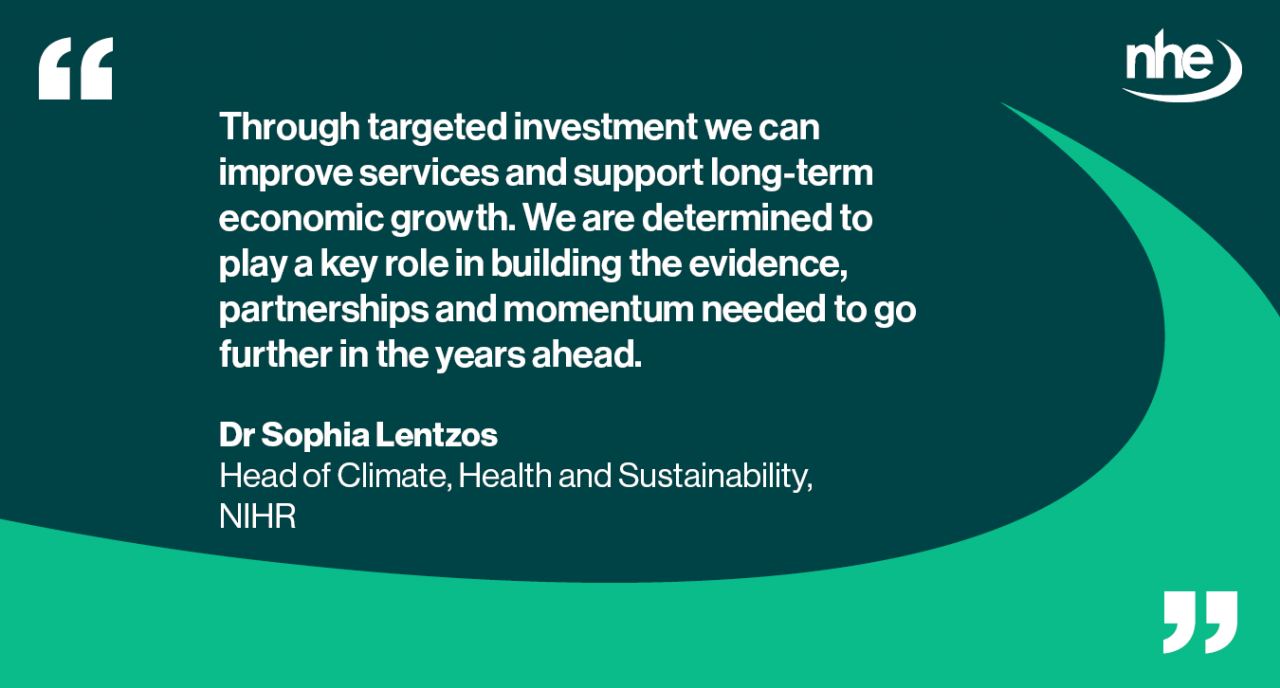
“Reducing the environmental impacts of the health and social care system, through cutting waste and using resources wisely, is not only one of our top priorities, it represents a significant opportunity as the NIHR reaches its 20th year. Through targeted investment we can improve services and support long-term economic growth. We are determined to play a key role in building the evidence, partnerships and momentum needed to go further in the years ahead.”
The NIHR's £25 million programme underlines the growing importance of sustainability within health and social care. Alongside environmental benefits, the funded projects are expected to generate evidence that can help reduce costs, improve productivity and enhance patient care.
As NHS organisations continue to balance rising demand with financial pressures, these studies could provide valuable insights into how innovation can support both sustainability goals and operational performance.
The first funding awards represent an important step towards creating a greener, more efficient and more resilient health and care system for the future.
Image credit: iStock