

The Medicines and Healthcare products Regulatory Agency (MHRA) has today launched a landmark public consultation on a proposed new regulatory framework designed to transform the development of treatments for rare diseases in the UK.
The consultation outlines a fundamentally new approach to how rare disease therapies are tested, licensed and monitored. The aim is clear: to make it quicker, safer, and less costly to bring innovative treatments to patients, while maintaining robust protections for patient safety.
Rare diseases affect more than 3.5 million people across the UK, yet fewer than 5% currently have an approved treatment. The MHRA’s proposal represents one of the most significant regulatory reforms in this area for decades.
At the heart of the proposal is recognition that the existing regulatory system was never designed for conditions affecting very small patient populations. Current clinical trial and licensing requirements assume large datasets and standard trial designs that are often impossible to achieve in rare and ultra‑rare conditions.
The new Rare Disease Therapies Regulatory Framework would apply to conditions affecting no more than one in 50,000 people, where there are clear, measurable barriers to running conventional clinical trials. Entry to the pathway would be guided by factors including disease severity, unmet clinical need, and the feasibility of generating traditional trial evidence.
Rather than lowering standards, the MHRA proposes a flexible, risk‑proportionate approach that reflects the realities of rare disease development while keeping patient safety at its core.
A central feature of the framework is the introduction of an Investigational Marketing Authorisation. This would combine clinical trial approval with a staged route towards full market authorisation.
In practice, this means patients could gain earlier access to promising therapies where evidence is necessarily limited, provided the benefits outweigh the risks. Any use within the NHS would remain subject to approval by the National Institute for Health and Care Excellence (NICE).
By compressing the regulatory pathway, the MHRA expects to reduce development costs and improve the commercial viability of rare disease therapies, helping to attract investment and, ultimately, improve affordability.
The framework has been developed in close partnership with the newly established Rare Disease Consortium. The consortium brings together patients, carers, researchers, clinicians, industry, and healthcare partners, ensuring that those most affected by rare diseases have helped shape the regulatory system governing their treatments.
This collaborative approach reflects a wider shift towards co‑design in health regulation, particularly in areas where traditional models have consistently failed to deliver.
The human impact of rare diseases is stark. Around one in 17 people in the UK lives with a rare condition. Diagnosis typically takes more than five years, and 30% of children affected by rare diseases die before the age of five.
The conditions themselves are hugely diverse. Some affect hundreds of people; others only a handful. Inherited retinal dystrophies lead to progressive sight loss. Angelman Syndrome, caused by a missing or faulty gene, means many children will never develop speech. Variants in the DHDDS gene cause a progressive neurological condition so rare that its full clinical picture is still emerging. Ultra‑rare cancers often have no targeted treatments at all. Myotonic Dystrophy gradually erodes muscle strength, affecting breathing and heart function as well as mobility.
What these conditions share is that the current system struggles to serve them.
The challenges of rare disease development are well known: small patient populations, limited scientific understanding and weak commercial incentives. Yet regulatory requirements have remained largely unchanged, continuing to rely on standards built around common diseases and large‑scale trials.
The consequences are significant. Delayed diagnosis alone is estimated to cost £340 million a year. Health‑related disability linked to rare diseases costs £4.7 billion annually, alongside an estimated £14.9 billion loss to the wider UK economy.
Against this backdrop, the MHRA’s consultation represents a decisive attempt to modernise regulation and better align it with scientific reality, patient need, and economic sustainability.
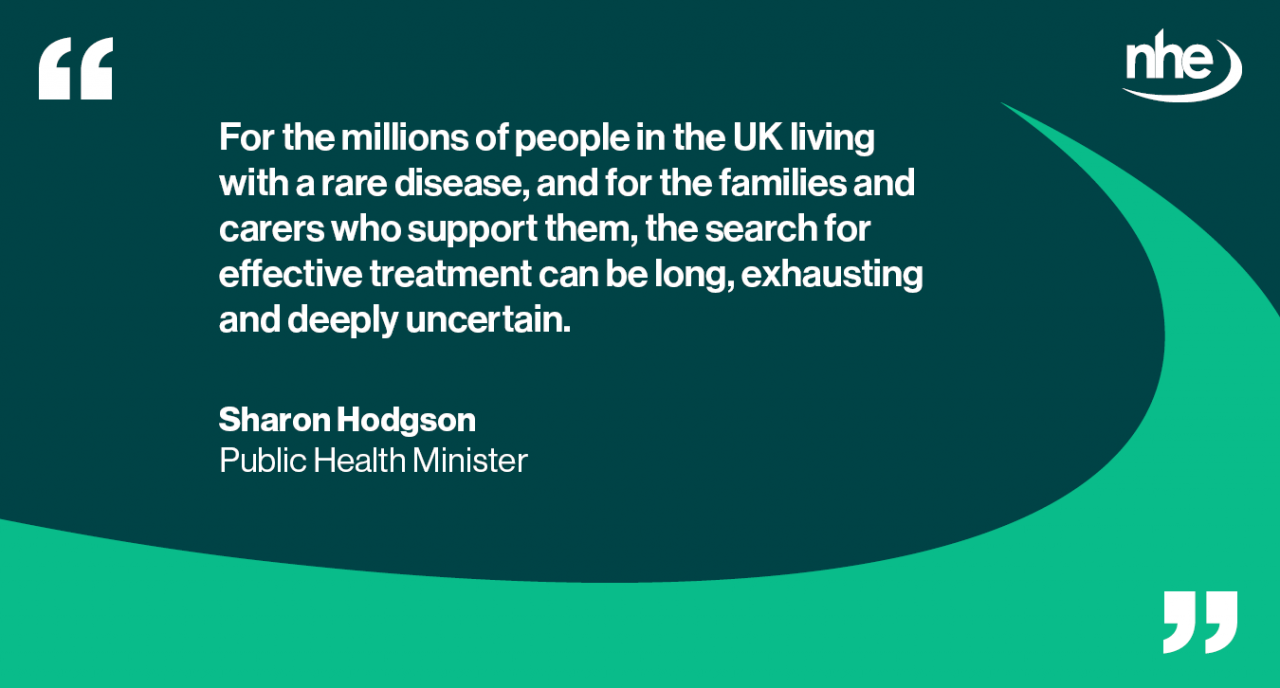
Sharon Hodgson, Public Health Minister, said:
“For the millions of people in the UK living with a rare disease, and for the families and carers who support them, the search for effective treatment can be long, exhausting, and deeply uncertain.
“These landmark proposals represent an important step towards a more agile and compassionate system - one that recognises the unique challenges of rare disease research while maintaining the highest standards of patient safety.
“By helping innovative therapies reach patients faster, this framework has the potential to transform lives, strengthen the UK’s position as a global leader in life sciences, and give renewed hope to families who have waited too long for progress.
“I encourage patients, clinicians, researchers and carers to take part in this consultation and help shape the future of rare disease treatment in the UK.”
For health leaders, life sciences organisations and policymakers, the consultation signals a clear direction of travel: a more adaptive regulatory system, designed to unlock innovation where it is currently most constrained.
Image credit: iStock