

Community pharmacies across England are set to take on a significantly expanded clinical role under a new £340 million government-funded agreement, aimed at improving patient access to care and easing pressures on GP and hospital services.
From Autumn 2026, pharmacists with an Independent Prescribing qualification will be able to assess patients and prescribe medicines directly, marking a major evolution of the Pharmacy First model. The move is expected to transform how patients access treatment for common conditions, delivering faster, more convenient care closer to home.
A Shift Towards Community-Based Care
The new contractual framework builds on the rapid growth of Pharmacy First, which has already demonstrated strong patient demand and satisfaction. Between March 2025 and February 2026, more than 3.3 million consultations were delivered—an increase of 43% year on year. Notably, 86% of patients reported a positive experience, highlighting the growing confidence in pharmacy-led care.
The introduction of independent prescribing in community settings is designed to reduce unnecessary referrals back to GPs while enabling pharmacists to deliver end-to-end care. Patients presenting with common illnesses will increasingly receive immediate treatment without needing to visit urgent care centres or A&E departments.
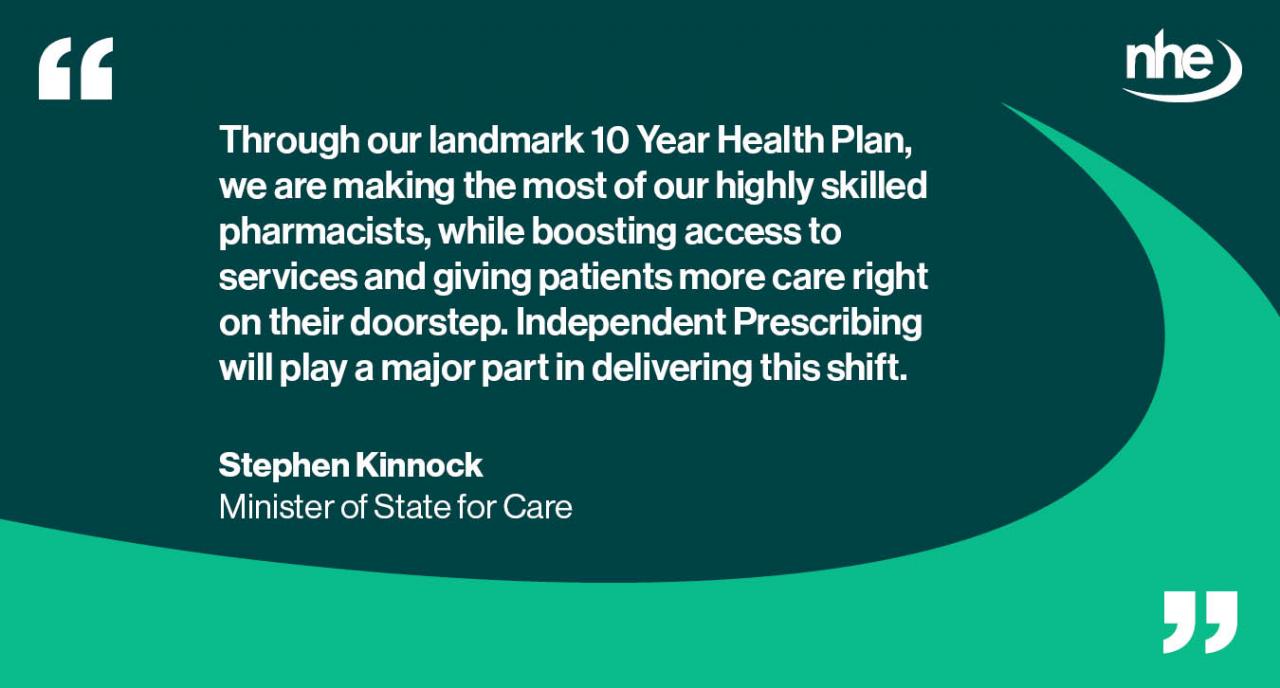
Minister of State for Care, Stephen Kinnock, emphasised the strategic importance of the change, stating:
“Through our landmark 10 Year Health Plan, we are making the most of our highly skilled pharmacists, while boosting access to services and giving patients more care right on their doorstep.
“Independent Prescribing will play a major part in delivering this shift – easing pressures on GPs, cutting unnecessary red tape and helping patients get the right care closer to home.”
What the £340 Million Investment Delivers
The funding package, agreed with Community Pharmacy England, underpins a broader transformation of pharmacy services. Alongside the rollout of independent prescribing, recent and ongoing measures include:
- Free access to the ‘morning-after pill’ via NHS pharmacies, eliminating postcode disparities
- Enhanced mental health support, including structured follow-up for patients prescribed antidepressants
- Greater workforce flexibility, enabling more pharmacy team members to deliver consultations and clinical services
- Expanded blood pressure monitoring and incentives to identify undiagnosed hypertension
- Increased funding to strengthen medicine supply chains
These changes reflect a deliberate policy shift towards moving care out of hospitals and into neighbourhood settings, aligning with the NHS 10 Year Health Plan and the development of Neighbourhood Health Services.
Reducing System Pressure and Improving Outcomes
Pharmacy First currently provides treatment and advice for a range of minor conditions affecting the ears, nose, throat, eyes, and skin, among others. By extending pharmacists’ prescribing authority, the NHS aims to streamline patient pathways and reduce duplication across primary care.
For NHS leaders and system managers, the implications are significant:
- GP workload reduction: fewer appointments for minor conditions
- Improved system flow: reduced pressure on urgent and emergency care
- Better patient experience: faster access and continuity of care
- Workforce optimisation: greater use of pharmacists’ clinical training
The expansion also addresses long-standing inefficiencies associated with Patient Group Directions (PGDs), which currently limit prescribing flexibility.
Implementation Timeline
The national rollout of independent prescribing in community pharmacy is scheduled to begin in Autumn 2026, with preparatory work underway to ensure workforce readiness, commissioning alignment, and public awareness.
For health system leaders, this announcement signals a pivotal opportunity to rethink care pathways and maximise the role of pharmacy within integrated care systems.
Image credit: iStock