


Value-based procurement has become an increasingly important ambition for the NHS. In principle, the idea is straightforward: purchasing decisions should consider the full value a technology can deliver across the clinical pathway, not just the upfront cost of the product itself.
In practice, however, that ambition is still difficult to achieve.
New research commissioned by Uniphar Medtech reveals the tension around value-based procurement. More than half (56%) of NHS decision-makers surveyed ranked price as the most important factor in formal tenders. Yet 59% identified total cost of ownership as their most important supplier-selection criterion, while the same proportion said they require health-economic and patient-outcome evidence when making value-based decisions.
Taken together, these findings suggest that NHS leaders want to make more evidence-led decisions, but are often operating within systems that still reward the lowest visible price. The result is a value-based purchasing gap: a disconnect between what healthcare organisations say they value and what procurement processes are able to prioritise.
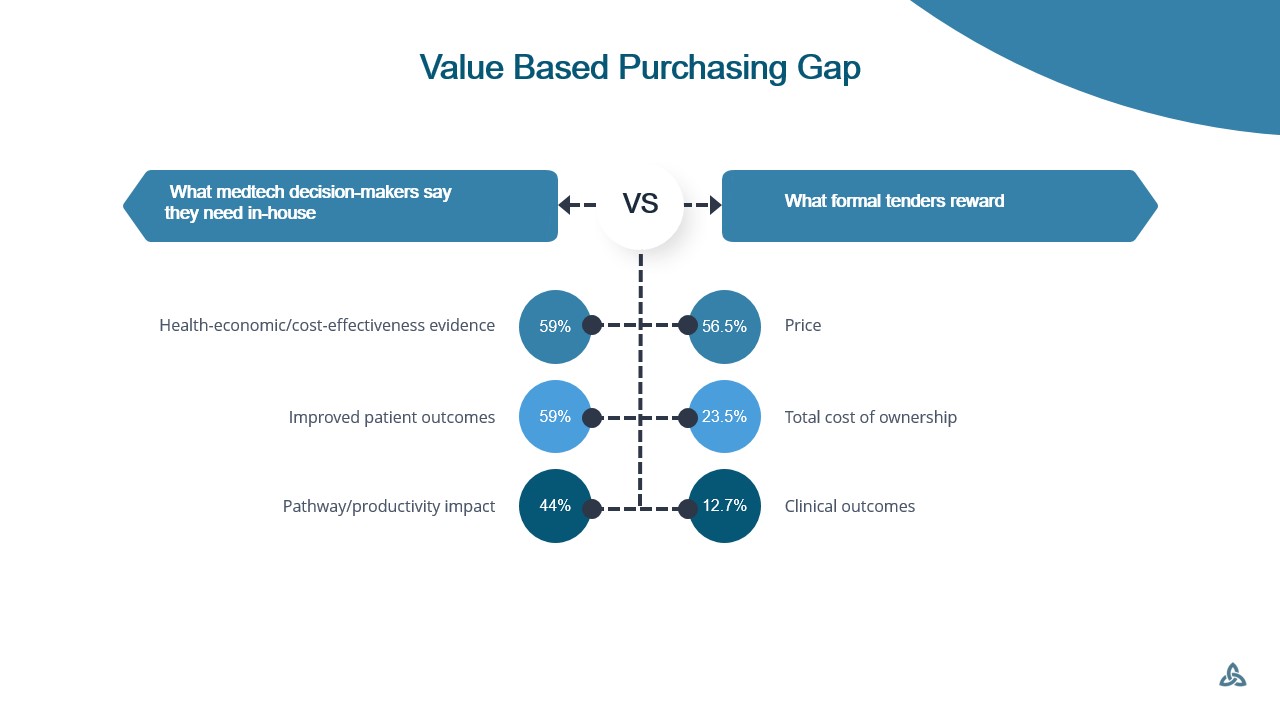
Healthcare leaders increasingly seek evidence of clinical and economic value, yet procurement decisions remain predominantly driven by upfront cost.
Price and value are not the same thing
The strongest message from the survey was the scale of financial pressure facing NHS organisations. Budget constraints were identified as the number one challenge facing trusts when it comes to medtech, cited by 85% of respondents.
In this context, it is understandable that procurement teams focus on managing upfront spend. Even when a technology promises long-term efficiencies or improved patient outcomes, higher upfront costs can present a significant barrier to adoption.
This creates what could be described as a value-based purchasing gap. NHS leaders recognise the importance of whole-life value, but the pressures of today's operating environment can make it difficult to prioritise anything beyond the initial purchase price.
However, the reality is that price and cost are not the same thing.
A technology or device may carry a higher price tag initially, but if it reduces theatre time, supports day-case treatment, shortens recovery or avoids repeat procedures, the overall value proposition can look very different. Viewed across the entire patient care pathway, cost savings and patient benefits may significantly outweigh the initial investment. Likewise, a piece of equipment that appears less expensive at the point of purchase may ultimately cost more when servicing, consumables, maintenance and support are considered.
The challenge for NHS organisations is determining how to assess that broader value consistently and confidently.

Lessons from working across the NHS
Our experience working with NHS organisations across multiple clinical specialties suggests that the most successful procurement decisions begin with a clear understanding of the problem that needs to be solved, rather than the product being purchased. Organisations are increasingly looking for partners that can help demonstrate outcomes, efficiencies and economic value, rather than just supply the equipment or technology. This requires a different conversation.
The medtech industry needs to help decision-makers understand how a solution will affect the broader patient pathway. Will it improve patient outcomes? Can it increase capacity? Does it support workforce productivity? Can it help reduce costs elsewhere in the system?
Importantly, many of the benefits generated by new technologies are realised beyond the department making the purchasing decision. A clinical team may require investment to introduce a new solution, while the resulting savings are delivered elsewhere through fewer complications, shorter admissions or reduced resource utilisation.
Without a broader view of value, these benefits can be difficult to capture.
The role of evidence and economic modelling
Clinical evidence and endorsement remains essential, but NHS decision-makers tell us they are most interested in health-economic or cost-effectiveness data (59% of respondents) and real-world patient and pathway or productivity outcomes (59%) that demonstrate the broader impact of an investment.
For the medtech industry, this means presenting a more complete value story. Together, clinical studies, health-economic analyses, local pilot or patient pathway data, and case studies can all help decision-makers assess whether a solution will deliver meaningful benefits within their own organisation.
Economic modelling is particularly important because it enables procurement teams to move beyond price and examine the likely impact of a technology across its full lifecycle.
Ultimately, evidence creates the bridge between value-based aspirations and practical purchasing decisions.

Turning aspiration into action
Our experience and research points to three key practical shifts that can go a long way to closing the value-based purchasing gap.
Firstly, a greater emphasis on total cost of ownership in procurement evaluations, taking into account servicing, maintenance, consumables, training and operational impact over the lifetime of a product.
Second, an increased focus on real-world evidence and outcome data to understand how technologies perform in practice, not just in theory.
Third, medtech partners and NHS stakeholders working together to build robust economic cases that quantify both clinical and financial benefits across the patient pathway.
The survey findings indicate that there is already broad recognition that value matters. The challenge now is ensuring procurement processes are equipped to measure, evaluate and reward it.
Price will always matter in a publicly funded health service, and rightly so. However, if medtech purchasing decisions are to deliver the greatest benefit for patients and the NHS alike, we must consider more than upfront cost alone.
Closing the value-based purchasing gap will require collaboration between healthcare providers, procurement teams, clinicians and industry partners. By bringing together robust evidence, health-economic insight and a shared focus on patient outcomes, it is possible to make procurement decisions that deliver value not only today, but across the lifetime of a technology. We welcome the opportunity to share experiences and contribute to these discussions as the NHS continues its journey towards more value-based healthcare.
To learn more about how Uniphar Medtech is supporting healthcare providers and partners across the sector, visit Uniphar Medtech Contact.