
Efforts to improve accident and emergency services in England are delivering only modest results, despite substantial investment and increased staffing levels, according to a new report from the National Audit Office.
The watchdog found that while NHS England has made some progress in tackling long waiting times and improving patient flow through hospitals, many of the ambitions outlined in its 2023 urgent and emergency care recovery plan have yet to be achieved.
Over the past decade, demand on emergency departments has continued to climb. Annual A&E attendances have risen by 6.5 million since 2011-12, contributing to growing pressure across the urgent and emergency care system.
The report highlights the extent of overcrowding facing frontline services. In May 2026, hospitals in England recorded an average of 2,241 patients waiting in A&E corridors and a further 669 patients waiting in corridors on hospital wards during a typical 24-hour period.
At the same time, costs have increased significantly. The average cost of a single A&E attendance reached £280 in 2024-25, representing a one-third increase compared with 2018-19.
The NHS Constitution's standard requires 95% of patients attending A&E to be admitted, transferred or discharged within four hours. However, this target has not been achieved since 2013-14.
The NAO acknowledged that performance has improved gradually since 2022-23, but progress remains slower than NHS England had hoped.
Performance challenges are particularly evident in Type 1 emergency departments, which manage the most complex and critically ill patients. These units continue to experience significantly longer waits than smaller Type 2 and Type 3 services.
The consequences for patients remain serious. The proportion of patients waiting 12 hours or longer in A&E has tripled since before the Covid-19 pandemic. Analysis from the Office for National Statistics suggests people experiencing waits of 12 hours or more are twice as likely to die within 30 days of leaving A&E compared with patients seen within two hours.
The report identifies patient flow through hospitals as one of the key barriers to improving emergency care performance.
Hospital admissions from A&E have increased by more than one million since 2011-12, placing additional pressure on inpatient capacity. When beds are unavailable, patients remain in emergency departments for longer, contributing to crowding and delays.
Delayed discharge remains a significant challenge. In 2025-26, 14.2% of hospital stays involved some form of discharge delay. These delays can stem from internal factors such as arranging take-home medications or from wider health and care system pressures, including limited capacity in care homes and community services.
The issue disproportionately affects older people and those living with frailty, according to Age UK.
NHS England estimates delayed discharges cost the health service around £2 billion between August 2025 and April 2026, while also restricting the flow of patients through hospitals and increasing pressure on emergency services.
In 2023, NHS England launched its urgent and emergency care recovery plan, identifying high bed occupancy and poor patient flow as major drivers of declining A&E performance.
To support improvements, NHS England allocated £1.6 billion through the discharge fund across 2023-24 and 2024-25, providing additional funding to integrated care boards and local authorities.
The NAO found that many of the actions outlined in the recovery plan were implemented successfully. However, NHS England's own evaluation concluded that several of the intended benefits have failed to materialise.
As a result, NHS England is now seeking to accelerate improvement through stronger accountability measures, greater use of financial incentives and a renewed focus on local leadership.
The watchdog is urging both NHS England and the Department of Health and Social Care to focus more closely on improving patient flow across hospitals.
Its recommendations include:
- Spreading successful approaches used by high-performing trusts across the NHS.
- Encouraging wider use of end-to-end hospital flow management tools.
- Reducing discharge delays caused within hospitals.
- Improving coordination between acute, community and social care services.
- Embedding patient experience measures into routine performance monitoring.
- Helping trusts better understand the relationship between costs, activity levels, case complexity, and performance.
Gareth Davies, Head of the NAO, said:
"Despite significant efforts to improve A&E performance, patients continue to experience long waits and delays in care. NHS England and DHSC need to understand more fully why improvements have been slow and ensure successful approaches are adopted more consistently across the system.
"A stronger focus on patient flow, timely discharge and patient experience will be vital to improving outcomes for patients."
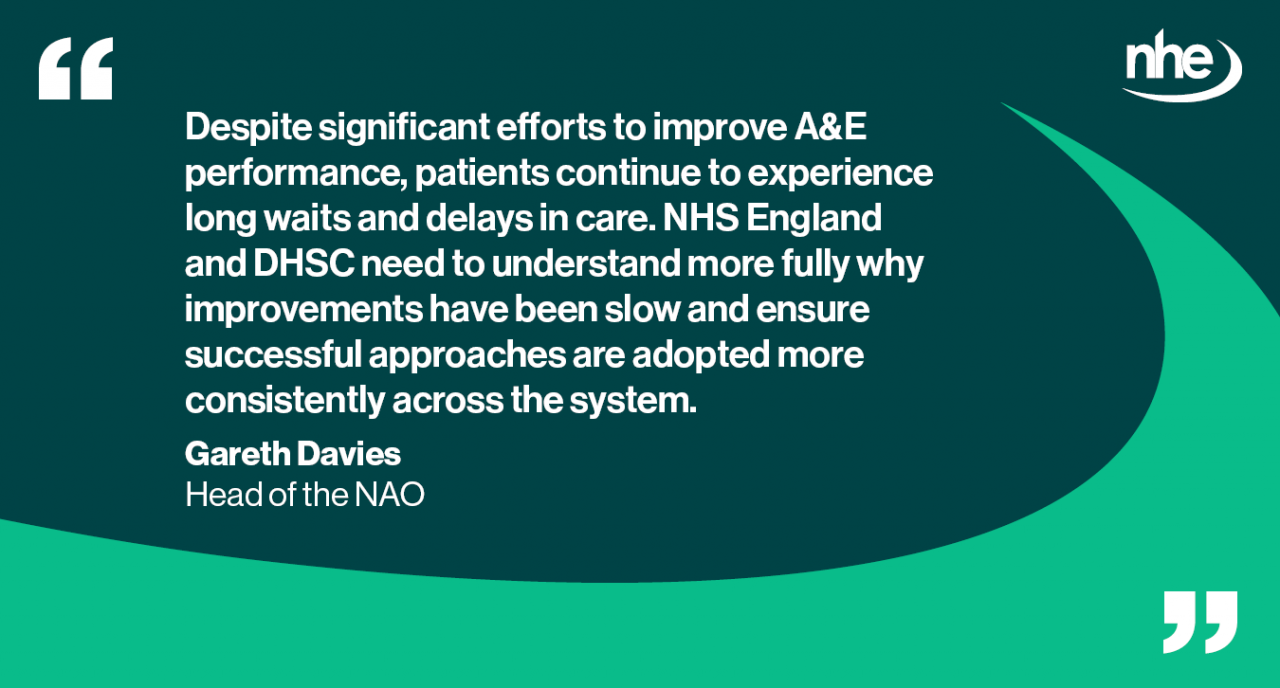
Image credit: iStock