


Nearly 30,000 people in England living with chronic obstructive pulmonary disease could see their lives transformed after the National Institute for Health and Care Excellence has recommended a new targeted treatment that can be taken at home.
The treatment, dupilumab, is the first biologic therapy shown to target both the symptoms of COPD and an underlying cause of the disease. Delivered via a simple pre‑filled pen that patients self‑inject every two weeks, the treatment offers new hope to people whose condition remains poorly controlled despite maximum inhaler therapy.
Clinical trials demonstrated that dupilumab reduced COPD flare‑ups by around 30%, with patients also reporting significant improvements in lung function and the ability to breathe more easily.
Flare‑ups, also known as exacerbations, are a major cause of hospital admissions and long‑term decline in people with COPD. Patient experts told NICE that flare‑ups often last one to two weeks, are extremely debilitating, and can severely affect people’s ability to work, maintain independence and carry out everyday activities.
Up to four in ten people with COPD have a specific type of inflammation identified by raised levels of eosinophils, a type of white blood cell. Dupilumab is the first treatment to specifically target this form of COPD.
The biologic works by blocking two key proteins involved in inflammation that drive symptoms and flare‑ups, bringing the disease under better control and addressing a key cause rather than just managing symptoms.
COPD is responsible for around 130,000 emergency hospital admissions each year in England. By significantly reducing flare‑ups, dupilumab has the potential to ease pressure on NHS hospitals and reduce reliance on steroid treatments, which are commonly used during exacerbations but can cause serious side effects with repeated use.
NICE estimates that if half of eligible patients receive dupilumab, there could be around 3,600 fewer COPD attacks, delivering potential savings of £16.5 million for the health service.
COPD is a chronic, progressive lung disease that causes airflow obstruction and makes breathing increasingly difficult. Common symptoms include shortness of breath, chronic cough and chest tightness, with many patients experiencing repeated flare‑ups that accelerate lung damage.
There are an estimated 1.2 million people diagnosed with COPD in the UK, with more severe forms of the disease also acting as a major risk factor for heart failure.
Under NICE’s recommendation, dupilumab will be available to adults with uncontrolled COPD who:
- Have raised blood eosinophil levels, and
- Have experienced at least one severe flare‑up, or two or more moderate flare‑ups, in the past 12 months,
- Despite being on maximum inhaler therapy.
Helen Knight, NICE’s Director of Medicines Evaluation, commented:
“This recommendation is a significant milestone for people with COPD. It offers patients an effective, targeted therapy that has shown impressive results - reducing flare-ups by around a third while improving lung function. This is better for patients and better for the NHS.
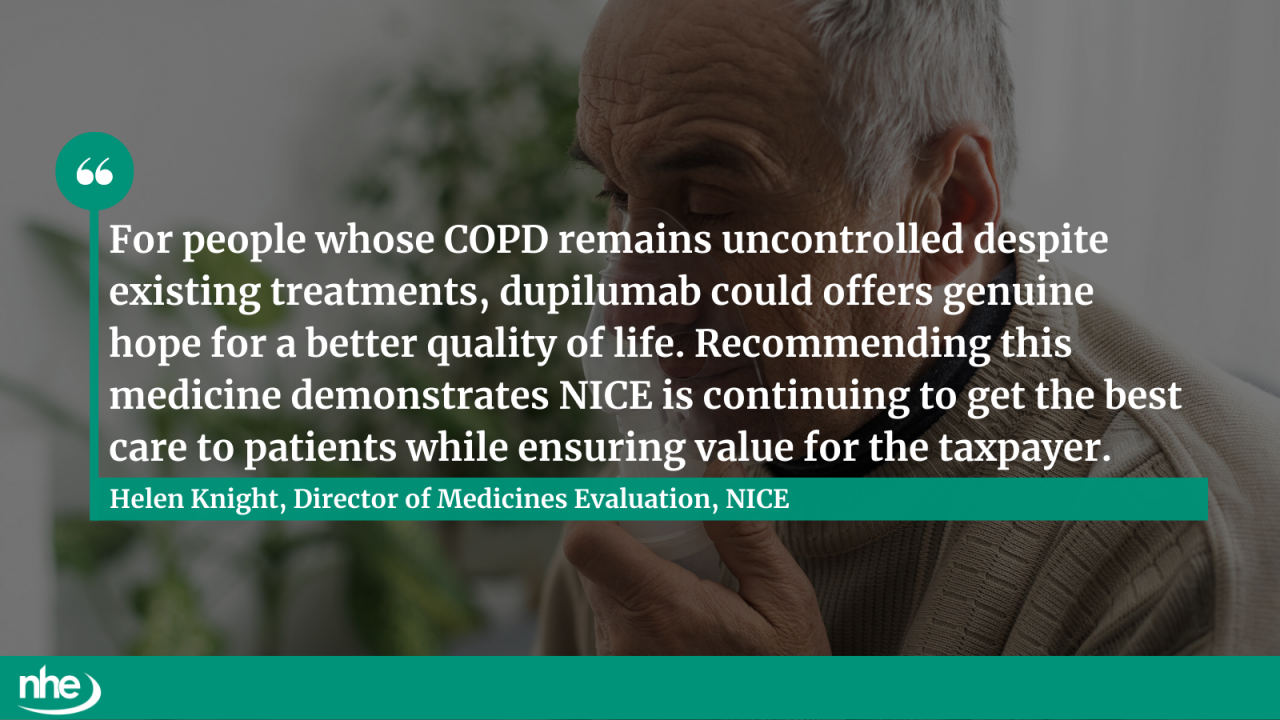
"For people whose COPD remains uncontrolled despite existing treatments, dupilumab could offers genuine hope for a better quality of life. Recommending this medicine demonstrates NICE is continuing to get the best care to patients while ensuring value for the taxpayer.”
NHS England has also negotiated an innovative commercial deal with French pharmaceutical company Sanofi, enabling the rollout of dupilumab for this new COPD indication.
The agreement ensures value for money while giving eligible patients access to a first‑in‑class treatment that could dramatically improve quality of life and long‑term outcomes.
NICE’s decision marks a major advance in COPD care, offering a new, targeted option for patients with limited alternatives and reinforcing the NHS’s commitment to adopting innovative treatments that deliver real benefits for patients and the health system.
Image credit: iStock