

The proportion of young people receiving disability benefits linked to ADHD and autism has risen dramatically across England, with the fastest growth recorded in some of the country's least deprived areas, according to new analysis from the Nuffield Trust.
The think tank examined changes in Personal Independence Payment (PIP) recipient rates among 16 to 17-year-olds between 2019 and 2025, assessing for the first time how those trends differ according to levels of deprivation.
The findings show that 51,148 young people aged 16 and 17 were receiving PIP for ADHD or autism in 2025, representing 3.4% of that age group. This compares with 16,045 recipients in 2019, when the rate stood at 1.3%.
While recipient rates remain highest in England's more deprived communities, the pace of growth has been significantly stronger in affluent neighbourhoods.
Between 2019 and 2025, the proportion of 16 to 17-year-olds claiming PIP for ADHD or autism in the least deprived fifth of neighbourhoods more than tripled, rising from 0.8% to 2.5%. By comparison, rates in the most deprived fifth increased from 2.1% to 5.1%.
As a result, the gap between the most and least deprived areas has narrowed considerably. In 2019, young people living in the most deprived neighbourhoods were around two and a half times more likely to receive PIP for ADHD or autism than those in the least deprived areas. By 2025, that difference had fallen to around two times.
The analysis highlights particularly steep increases in areas traditionally regarded as prosperous.
By 2025, recipient rates in Runnymede and Bracknell Forest had reached approximately one in 19 and one in 20 young people respectively. Six years earlier, those figures stood at around one in 58 and one in 89.
Despite the rapid growth in affluent areas, some of England's most deprived local authorities continue to record the highest overall recipient rates.
In Liverpool and Knowsley, around one in 12 young people aged 16 to 17 were receiving PIP linked to ADHD or autism by 2025. In 2019, rates were approximately one in 35 and one in 57 respectively.
Researchers also identified notable differences among ethnic groups.
PIP recipient rates for people of White ethnicity were found to be higher overall than those recorded for other ethnic groups. This may help explain lower-than-expected recipient rates in ethnically diverse areas such as Newham, Brent and Leicester, despite those locations experiencing relatively high levels of deprivation.
The report suggests this pattern may reflect wider inequalities in diagnostic access and support pathways.
The increase in claims has also translated into substantial growth in benefit expenditure.
Of the estimated £296 million spent on PIP claims for 16 to 17-year-olds with ADHD and autism in 2025, approximately £87 million was paid to young people living in the 40% least deprived neighbourhoods. This represents a real-terms increase of nearly 300% compared with £22 million in 2019.
Looking across the wider 16 to 19 age group, analysts estimate total PIP payments linked to ADHD and autism in the 40% least deprived areas exceeded £220 million in 2025, up from £64 million six years earlier.
The report notes that the weakening relationship between deprivation and disability benefit claims appears unique to ADHD and autism.
Researchers found no similar pattern among PIP claims relating to learning disabilities, anxiety, depression or physical disabilities in the same age group.
This finding challenges suggestions that the trend is simply linked to wider economic pressures or the cost-of-living crisis, as similar increases have not been observed across other disability categories.
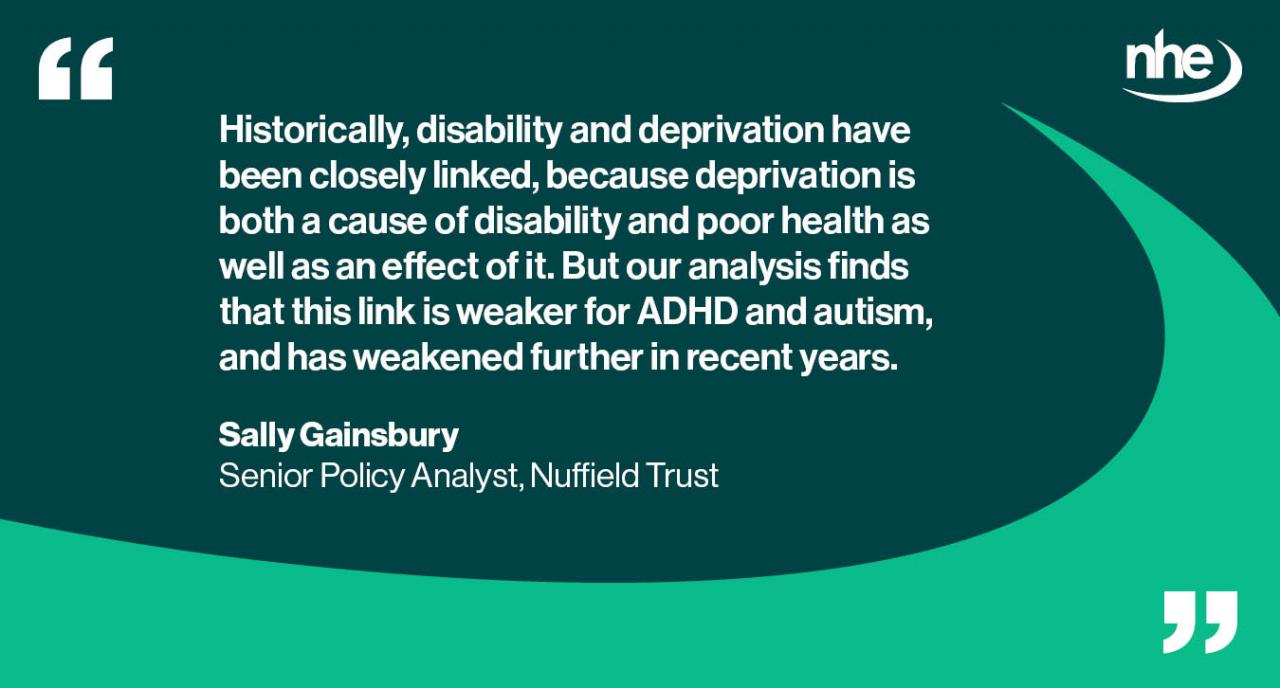
Sally Gainsbury, Senior Policy Analyst at the Nuffield Trust, said:
“Historically, disability and deprivation have been closely linked, because deprivation is both a cause of disability and poor health as well as an effect of it. But our analysis finds that this link is weaker for ADHD and autism, and has weakened further in recent years.
“PIP is meant to reflect how much a condition affects someone’s day-to-day life, rather than purely whether they have a diagnosis, so it’s intriguing to see that recipient rates have grown most in the areas where people seem to be doing relatively well in terms of employment and education. Our findings could reflect unequal access to diagnosis, which we know is substantial.
"But they could also point to inconsistencies and uncertainties, both in the welfare system and in wider society, about how disability is understood and assessed when it comes to autism and ADHD. This confusion has serious implications for the health system too. Demand for diagnosis and treatment has risen dramatically, and services are struggling to keep pace. Overwhelmed systems risk missing people with the most pressing need.”
Healthcare leaders and policymakers are likely to view the findings as further evidence of mounting pressure across neurodevelopmental services, with growing demand for diagnosis, assessment and support continuing to outstrip capacity in many parts of the NHS.
Image credit: iStock