

Around 1,600 people a year in England with multiple myeloma are set to benefit from a new treatment option following a recommendation by the National Institute for Health and Care Excellence.
In final draft guidance, NICE has recommended belantamab mafodotin (also known as Blenrep) in combination with bortezomib and dexamethasone. This means the treatment can be offered on the NHS from today for adults whose cancer has come back after previous therapy.
Multiple myeloma is a cancer of the plasma cells, found primarily in the bone marrow. While it is not currently curable, treatment can help bring the disease under control for periods of time.
Patients typically experience cycles in which the disease worsens, followed by treatment to restore remission. Patient experts told NICE’s independent committee that the condition can be highly debilitating, with complications that severely affect day‑to‑day life. The constant risk of relapse also places a significant psychological burden on patients and their families.
Belantamab mafodotin works differently from many existing myeloma treatments. Rather than killing cancer cells directly, it uses a targeted approach often described as a “Trojan horse” mechanism.
An antibody is used to carry a toxic drug directly to the myeloma cells, delivering treatment precisely where it is needed. This makes it particularly valuable for people whose cancer has stopped responding to other treatments, or for those who cannot tolerate standard therapies.
Clinical evidence reviewed by NICE shows that belantamab mafodotin, when used with bortezomib and dexamethasone, extends the length of time before the disease worsens compared with the commonly used combination of daratumumab, bortezomib and dexamethasone.
Early trial results also suggest patients may live longer with the new treatment combination, although NICE notes that the trial is still ongoing and some uncertainty remains around long‑term outcomes.
NICE’s earlier draft guidance had limited the treatment to people who had received one prior therapy that included lenalidomide, and whose disease no longer responded to or tolerated that drug.
The updated recommendation is broader, allowing access for anyone who has had one previous line of treatment, regardless of whether lenalidomide was used. This expansion is expected to significantly increase the number of patients who can benefit.
NICE expects to publish its final guidance later this month. In the meantime, interim funding for belantamab mafodotin in combination with bortezomib and dexamethasone will be made available immediately through the Cancer Drugs Fund, ensuring eligible patients can access treatment without delay.
Helen Knight, NICE’s Director of Medicines Evaluation, said:
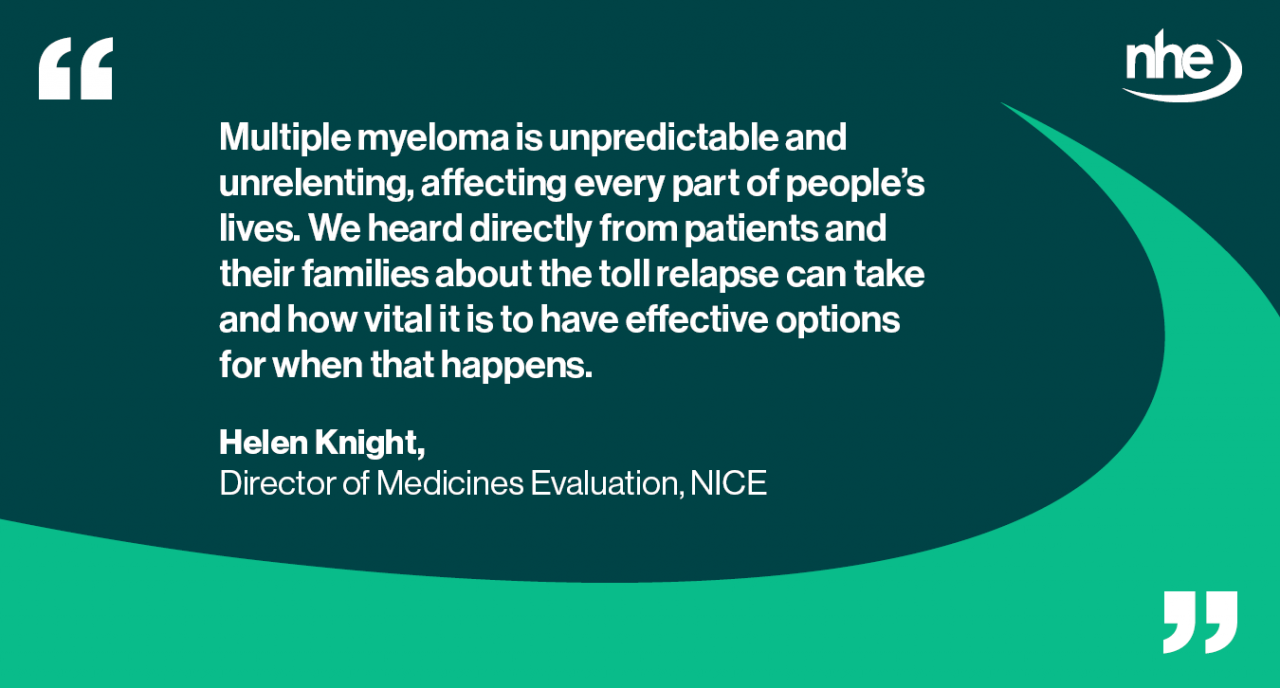
“Multiple myeloma is unpredictable and unrelenting, affecting every part of people’s lives. We heard directly from patients and their families about the toll relapse can take and how vital it is to have effective options for when that happens.
“We also heard from clinicians and patients about how this treatment could be used in the NHS, and we’ve worked with the company to ensure more patients are now able to benefit from it, providing the hope of a meaningful delay in their disease getting worse.”
By widening eligibility and supporting interim access, the new NICE recommendation aims to give patients greater choice, better disease control and improved quality of life at a critical stage of their treatment journey.
Image credit: iStock