

The National Institute for Health and Care Excellence (NICE) has recommended that some newborn babies receiving antibiotics in hospital could safely switch to oral medication and complete treatment at home, potentially reducing hospital stays by several days.
The updated guidance aims to improve care for families while also easing pressure on NHS neonatal services by freeing up beds for babies requiring more intensive support.
Under the new recommendations, eligible newborns could leave hospital sooner and continue their course of antibiotics at home with ongoing clinical support.
NICE estimates this approach could reduce hospital stays by up to 2.7 days per baby, allowing families to spend more time at home while still receiving safe and effective care.
For mothers, this change may significantly improve recovery and bonding time with their babies outside a hospital setting.
All newborns who may be at risk of infection are currently assessed for factors such as:
- Premature birth before 37 weeks
- Maternal group B strep infection
- Suspected maternal sepsis during labour
Babies with identified risks undergo immediate clinical assessment and, where necessary, begin intravenous (IV) antibiotic treatment.
Under the new guidance, babies may be eligible to switch to oral antibiotics and go home if they:
- Are born after 35 weeks of pregnancy
- Test negative for infection
- Are clinically stable
- Are feeding well
- Are responding as expected to treatment
Some babies will still need to remain in hospital, particularly those requiring more intensive care or monitoring.
The recommendation follows successful pilot schemes conducted across nine NHS sites in England, where the approach was tested in real‑world settings.
The evidence shows that babies who completed their treatment at home had equivalent outcomes to those who remained in hospital, demonstrating that the model is both safe and effective.
Data from the NOAH Project in Devon, one of the pilot schemes, suggests that up to 12,000 babies each year in England could benefit from the change if implemented nationally.
The project also found a reduction in hospital stay of 2.7 days on average, highlighting the significant potential for both improved patient experience and system efficiency.
By shortening hospital stays where clinically appropriate, the guidance could help ease pressure on busy neonatal units, which often operate at high capacity.
Freeing up beds allows hospitals to:
- Prioritise babies requiring specialist or intensive care
- Improve patient flow across neonatal services
- Reduce strain on healthcare staff and resources
This is particularly important in supporting safe and sustainable service delivery across the NHS.
The move reflects a broader shift towards family‑centred, personalised care, enabling treatment to be delivered in the most appropriate setting.
Home‑based care can offer benefits such as:
- Reduced stress for families
- Improved bonding between parents and newborns
- Lower risk of hospital‑acquired infections
At the same time, ongoing clinical oversight ensures that safety remains a top priority.
Alongside the discharge recommendations, NICE has clarified guidance around assessing infection risk linked to rupture of membranes (waters breaking). The updated advice highlights that the total time between waters breaking and birth is the key factor in assessing infection risk, and this applies regardless of whether waters break before or during active labour.
This clarification supports more consistent clinical decision‑making across maternity and neonatal services.
NICE Centre for Guidelines Interim Director, Eric Power, said:
“These updated recommendations will improve how some mothers experience the first few days with their new baby.
"We know the first days with a new baby can be overwhelming, especially if your baby is being treated for a suspected infection.
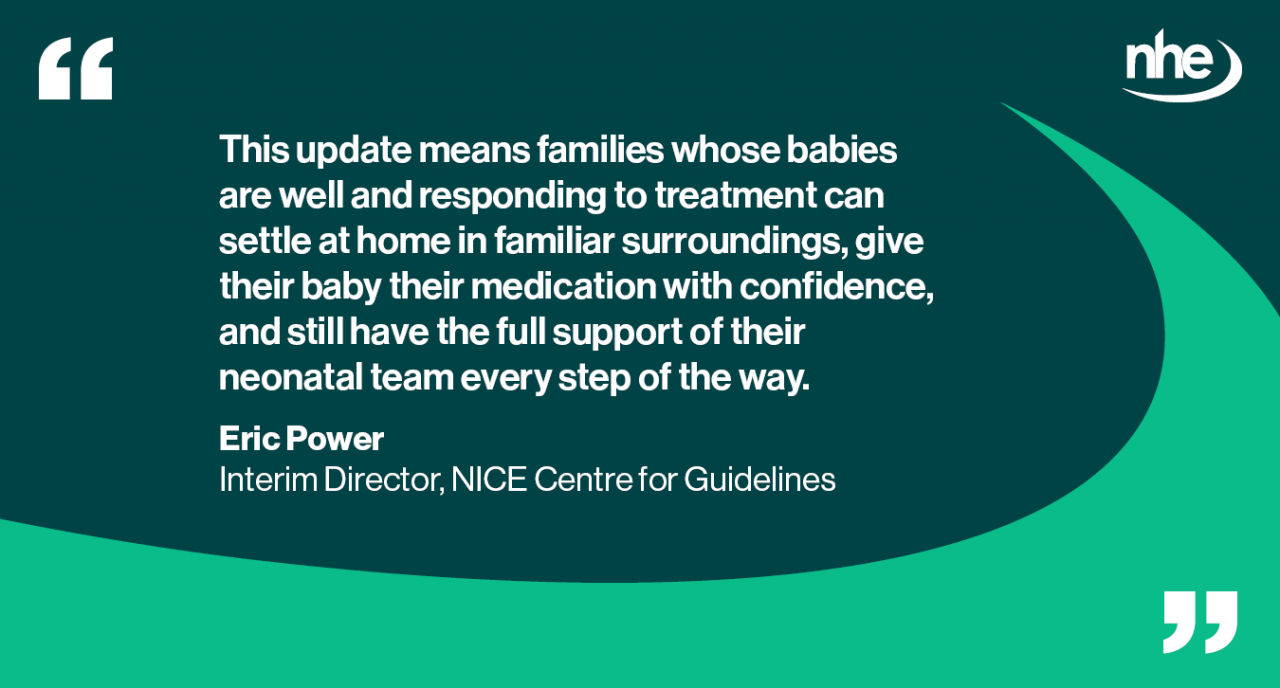
“This update means families whose babies are well and responding to treatment can settle at home in familiar surroundings, give their baby their medication with confidence, and still have the full support of their neonatal team every step of the way.”
By enabling more babies to complete treatment at home, the NHS can:
- Improve care for families
- Reduce unnecessary hospital stays
- Use resources more effectively
With strong evidence supporting its safety and effectiveness, the approach is expected to be adopted more widely across NHS services in England.
If rolled out nationally, it could transform the experience of care for thousands of families each year, ensuring that babies receive the treatment they need while allowing them to return home sooner.
Image credit: iStock