


Smoking continues to be the largest avoidable cause of death and disability in the UK, but its effects are increasingly concentrated among society’s most disadvantaged groups, according to a new report from the Royal College of Physicians (RCP).
The report, Smoking, health and social justice, sets out the unequal and far‑reaching impact of tobacco use on health, employment, and the economy, and calls for the introduction of opt‑out tobacco dependency treatment across all NHS services as a matter of urgency.
The RCP warns that while overall smoking rates have declined, the burden of smoking‑related harm is becoming more concentrated among people facing:
- Poverty and unemployment
- Mental health conditions
- Insecure housing and social exclusion
Geographical disparities remain stark. In Blackpool, one of the most deprived areas in the UK, nearly 20% of people smoke, compared with just 4% in affluent areas such as Woking.
The report argues that these inequalities reflect wider social and economic conditions, and that addressing smoking requires action beyond healthcare alone.
A central recommendation of the report is the introduction of opt‑out smoking cessation services across all NHS settings. Under this model, anyone who smokes and has contact with NHS services, including hospitals, GP practices, and community care, would be automatically referred to stop smoking support, unless they choose to opt out.
The RCP says evidence from existing NHS inpatient programmes shows that removing barriers to access leads to higher quit rates, particularly among those in the most disadvantaged communities.
The report highlights the significant economic toll of smoking on the UK.
Key findings include:
- Around £8.9 billion a year lost due to reduced employment linked to smoking‑related illness
- Smokers earning around 9% less than non‑smokers, contributing to £11 billion in lost earnings annually
- A further £1.35 billion in lost productivity due to premature deaths, particularly among workers aged over 45
- A potential £10.9 billion “smoke‑free dividend” if smoking were eliminated, alongside the creation of around 135,000 jobs
The RCP says reducing smoking prevalence would not only improve health but also strengthen economic growth and workforce participation.
The report also raises concerns about gaps in official data, particularly among “hidden populations.”
People who are homeless or entering prison are more than six times as likely to smoke as the general population. With an estimated 1.9 million adults lacking stable housing, the RCP suggests smoking rates may be significantly higher than recorded figures indicate.
Despite high motivation to quit among many disadvantaged groups, barriers such as financial stress, unstable living conditions and limited access to support reduce their chances of success.
A 2025 survey of RCP members highlights the ongoing clinical impact of smoking.
More than half of physicians (53%) reported that at least 50% of their caseload involves patients whose conditions are caused or worsened by smoking.
The RCP says this underlines the need for prevention and early intervention to reduce demand on NHS services.
To tackle smoking‑related health inequalities, the RCP is calling on the government and health system leaders to take a more integrated and targeted approach.
Recommendations include:
- Introducing opt‑out smoking cessation services across all NHS settings
- Targeting policy and resources towards high‑prevalence and underserved groups
- Strengthening regulation of tobacco pricing, availability, and marketing
- Investing in better data collection to identify and support hidden populations
- Adopting a cross‑government approach to address the influence of industries that contribute to poor health, including tobacco, alcohol, food, and gambling
The RCP emphasises that smoking is not simply a matter of individual choice, but is shaped by wider social and economic conditions.
Professor Sanjay Agrawal, Special Adviser on Tobacco at the RCP, commented:
“Over the past 30 years, smoking has claimed roughly three million lives in the UK and continues to place a huge and entirely avoidable burden on the economy. But its impacts are increasingly concentrated among people already living in poverty, poor health, and social exclusion. Both the health and economic costs of smoking fall most heavily on the people and communities who can least afford them.
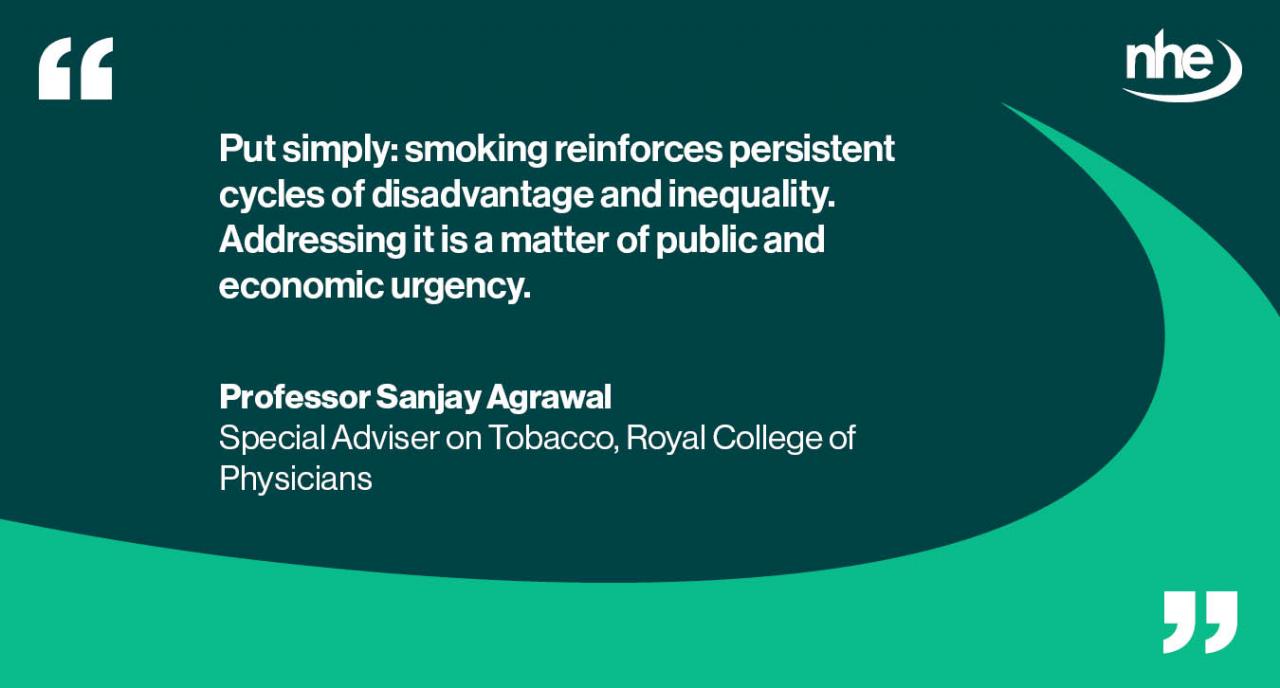
“Put simply: smoking reinforces persistent cycles of disadvantage and inequality. Addressing it is a matter of public and economic urgency.
“Opt out smoking cessation pathways reduce inequality by removing the barriers that prevent people from accessing treatment, particularly in more deprived areas where smoking rates are highest and awareness of support is lowest. NHS inpatient data already show that when support is offered as standard, the greatest quit success is seen among the least advantaged groups, delivering both health and economic returns. Opt out reaches the people our current system consistently fails.”
Factors such as insecure employment, poor housing and social disadvantage play a significant role in both uptake and the ability to quit.
Without addressing these underlying drivers, the College warns, progress in reducing smoking‑related harm will remain uneven.
The report concludes that stronger, coordinated action is needed to reduce smoking prevalence and close the gap in health outcomes between different communities.
By expanding access to evidence‑based support, particularly through opt‑out NHS services, the RCP says the UK can save lives, reduce inequalities, and deliver significant economic benefits.
Image credit: iStock