

The Medicines and Healthcare products Regulatory Agency (MHRA), working closely with NHS England, has published new guidance that provides much-needed clarity on how existing medical device regulations apply to AI-enabled ambient voice technology (AVT) products used across health and care settings in Great Britain.
The move is expected to accelerate the safe adoption of AI-powered clinical documentation tools across the NHS, supporting the wider ambition of making the NHS the most AI-enabled health system in the world.
Ambient voice technology, often referred to as AI scribes, is increasingly being deployed by NHS organisations to capture, transcribe and summarise conversations between clinicians and patients. By automating administrative tasks such as note-taking and letter drafting, the technology has the potential to reduce clinician workload and free up more time for direct patient care.
Under the new guidance, the MHRA confirms that AVT products used solely for transcription, summarisation of clinical conversations, drafting correspondence, or recommending clinical codes for review by a healthcare professional are not classified as medical devices under current UK regulations.
This distinction removes uncertainty for NHS organisations seeking to introduce lower-risk AI tools while ensuring that appropriate safeguards remain in place.
NHS England has also issued supporting guidance to help organisations assess, procure and implement ambient scribing products safely and effectively across healthcare settings.
However, the guidance draws a clear regulatory boundary. AVT products designed to support clinical decision-making, diagnosis, treatment or disease prevention, or those capable of taking automated actions without clinician oversight, remain subject to medical device regulations and must meet stringent safety and performance requirements.
Importantly, the guidance does not introduce new legislation. Instead, it explains how existing medical device laws should be interpreted and applied to this rapidly evolving technology. The document has been informed by feedback from NHS clinicians, technology experts and patient safety representatives, while also aligning with the direction of the National Commission into the Regulation of AI in Healthcare.
Lawrence Tallon, Chief Executive Officer, MHRA said:
“This guidance is an important step forward for the safe and confident adoption of AI in healthcare settings.
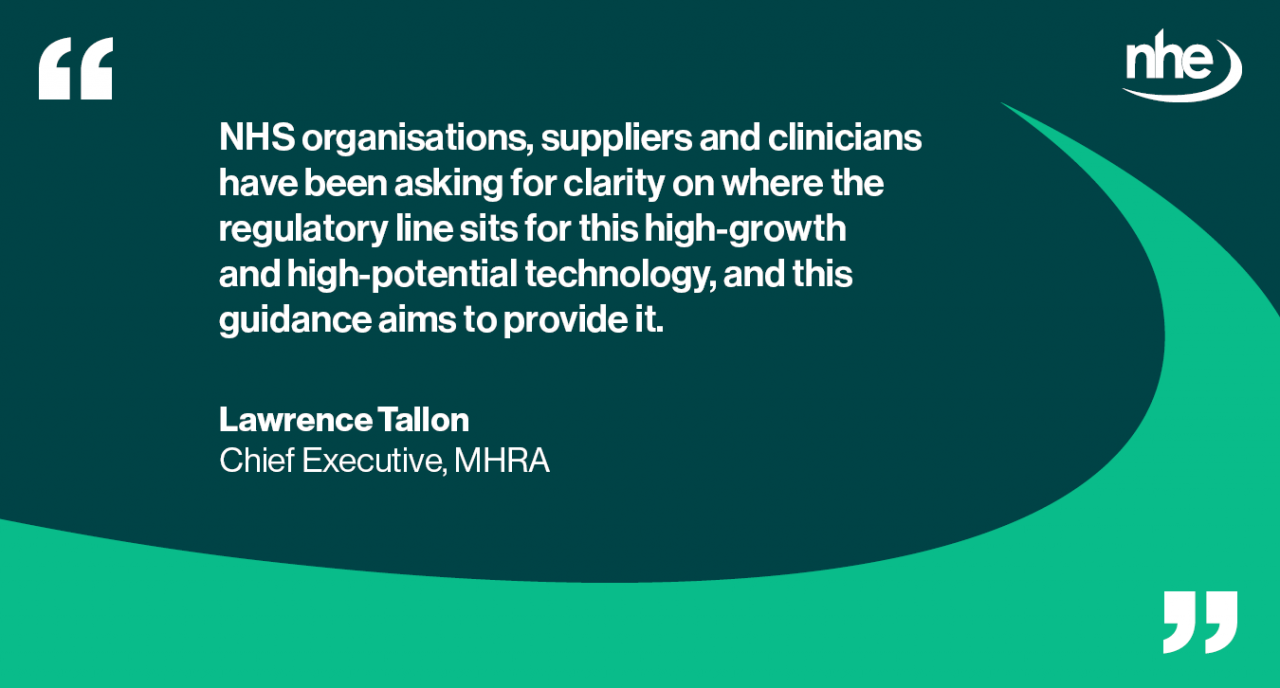
“NHS organisations, suppliers and clinicians have been asking for clarity on where the regulatory line sits for this high-growth and high-potential technology, and this guidance aims to provide it.
“We are setting out which functions of ambient voice technologies are deemed medical devices and which are not in order to remove ambiguity. This will help to unlock faster uptake of lower risk tools that significantly reduce the burden of administrative work, such as transcribing or summarising conversations, in turn, giving clinicians more quality time focusing on patients.
“Crucially, where a product supports diagnosis or treatment, regulatory protections will still apply.”
The MHRA has emphasised that clinicians remain fully responsible for reviewing and validating AI-generated transcripts, summaries, clinical codes and letters before they are used in patient care. The introduction of AVT tools does not alter professional accountability or clinical governance requirements.
NHS boards and executive leaders are also being encouraged to ensure that any deployment of ambient voice technology is underpinned by robust governance arrangements, appropriate staff training, strong procurement processes and ongoing clinical oversight.
Organisations are further advised to monitor any future changes to AVT functionality, particularly where new features could alter a product's regulatory classification and introduce additional compliance requirements.
As AI continues to transform healthcare delivery, the MHRA and NHS England have confirmed they will continue working together to develop further guidance, ensuring regulation evolves alongside innovation while maintaining patient safety and public trust.
Image credit: iStock