

The National Institute for Health and Care Research has awarded almost £700,000 to support seven development award research projects focused on understanding and addressing the impacts of climate change and extreme weather on health and social care delivery across the UK.
The funding represents an important first step in a longer‑term programme to strengthen the resilience of health and social care systems, helping them adapt to growing environmental pressures such as extreme heat, flooding and storm surges.
Climate change is already affecting the UK’s ability to deliver safe and effective care. Heatwaves can place significant strain on hospital infrastructure and staff, while flooding and severe weather disrupt access to care homes, community services and essential facilities. The effects are felt most acutely by vulnerable populations, including older people, those with long‑term health conditions and individuals reliant on social care.
Through the NIHR Climate Change and Health Development Awards, research teams have been funded to develop and test new ideas that help health and social care services adapt during periods of extreme weather. In total, £690,750 has been invested, with each project receiving up to £100,000 to support preparatory work ahead of larger research collaborations.
The funded projects will focus on building research capacity in climate change and health adaptation, strengthening partnerships between academics, healthcare professionals and policymakers, and developing robust research methods and access to essential data. Teams will also work to identify evidence gaps and assess the effects of extreme weather on infrastructure, staffing and service delivery, with a particular emphasis on protecting those most at risk.
This initial investment is designed to seed the next phase of more ambitious research, supporting award holders to develop plans and prepare bids for the NIHR Climate Change and Health Research Collaboration Awards. These larger awards—open to all researchers, whether or not they received a development award—will provide up to £2 million per project, supporting major, programme‑level research over a period of up to three years.
Together, the two funding schemes mark a significant long‑term investment by the Department of Health and Social Care and NIHR, embedding climate resilience firmly within the future of UK health and social care.
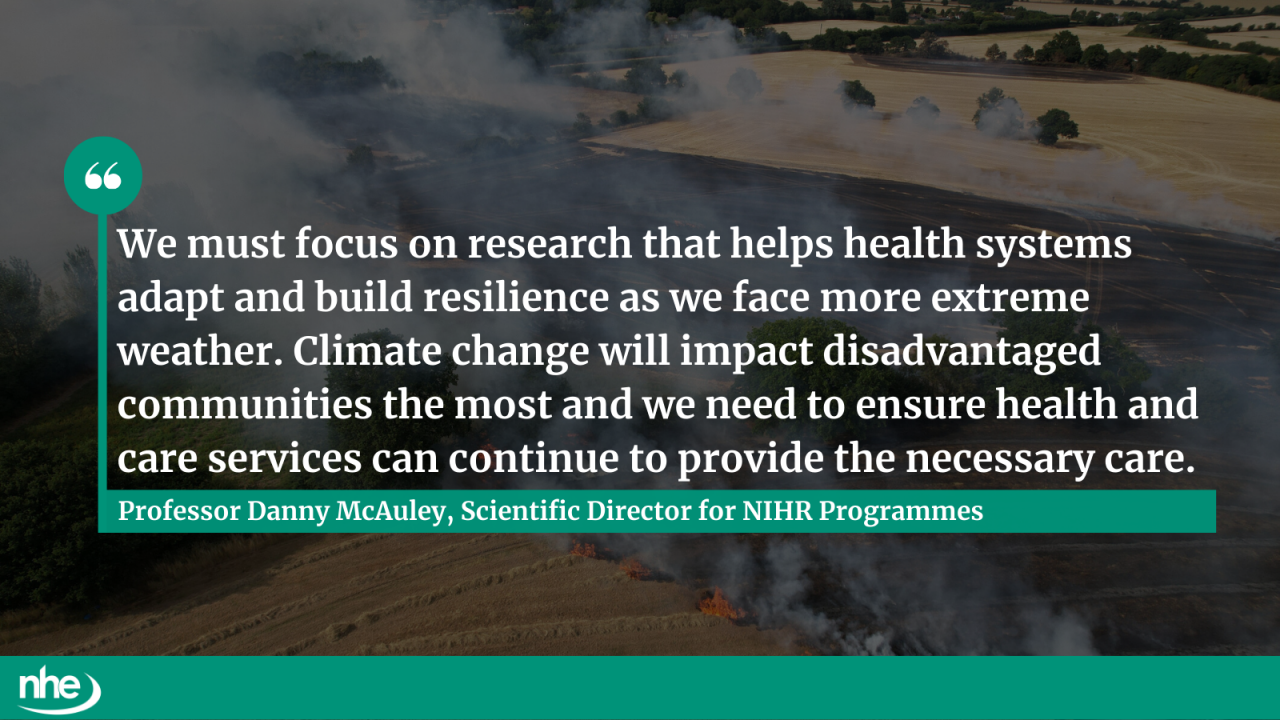
Scientific Director for NIHR Programmes, Professor Danny McAuley, said:
"We must focus on research that helps health systems adapt and build resilience as we face more extreme weather. Climate change will impact disadvantaged communities the most and we need to ensure health and care services can continue to provide the necessary care. It will also deepen existing health inequalities. That’s why these projects, which are focusing on some of the most vulnerable populations, are more important now than ever before."
The growing importance of climate resilience has been reflected on the international stage through the rising prominence of UN Climate Change Conferences over the past two decades. At COP26 in Glasgow, Professor Lucy Chappell, Chief Scientific Adviser to DHSC and Chief Executive of the NIHR, highlighted the urgent need for high‑quality evidence to meet the health challenges posed by climate change, identifying it as a strategic priority for NIHR.
NIHR leaders say the new funding will help create the evidence base needed to protect patients, staff and services, ensuring the UK’s health and social care system remains resilient in the face of a changing climate.
Image credit: iStock